Ascolto, linguaggi, tecnologie, storia, geopolitica, cultura della radio: emittenti locali, internazionali e pirata • Web radio • radio digitale • streaming music • ham radio • software defined and cognitive radio • radiocomunicazioni • regolamentazione
14 aprile 2016
Una frequenza per Expressa: il giovane radiocronista ucciso dalla trucha simbolo della riforma delle Tlc in El Salvador.

15 gennaio 2015
Metto la radio in valigia e riparto per raccontarla.
07 giugno 2013
Unesco: cercasi valutatori per un progetto di informatizzazione di 32 emittenti africane
UNESCO invites external independent evaluators to assess the implementation of the project “Empowering Local Radios with ICTs” and to produce a mid-term external evaluation report.
The report should evaluate the relevance of objectives and progress made to achieve them. It will be used by UNESCO to assess the implementation of activities gearing to results and consider adjustments. UNESCO, with support from the Swedish International Development Cooperation Agency (SIDA), is executing a three-year project entitled “Empowering local radios with ICTs” in 32 radio stations located in Democratic Republic of the Congo, Kenya, Lesotho, Namibia, South Africa and Zambia.The project intends to increase the quality of local radio programming and broadcasting by fully integrating the use of ICTs, strengthening local reporting on development issues and engaging poor people’s participation in debates related to their livelihood and development.A mid-term evaluation has been planned in order to demonstrate achievements realised between the start of project’s full implementation (15 March 2012) and 15 July 2013, and to make suggestions for the following period. More particularly, the evaluation report aims to:
- enhance the project’s relevance, efficiency and effectiveness;- suggest improvements for the following stage of implementation and project replication;- demonstrate the project’s achievements, challenges and lessons learned;- Generate findings regarding the effectiveness of trainings in local radios and its effects on community, especially women and girls;- indicate any risks that may compromise the successful implementation of the project and suggest actions to overcome it.
The evaluation is expected to start on 15 July 2013. The final report must be delivered by 31 October 2013. UNESCO invites interested external independent entities and individual evaluators to submit their proposals, according to the Terms of Reference, by email to Jonathas Mello on or before 24 June 2013, 9 a.m. (Paris time). Proposals must consist of the following:
- description of the research methodology (including strategy to achieve an assessment per country);- timeline;- competitive fee in US dollars;- company description (if applicable); and- relevant examples of previous work.
The evaluator should comply with the following requirements: extensive knowledge of, and minimum five years’ experience, in applying qualitative and quantitative evaluation methods; proven record in designing and leading evaluations; a minimum of ten years’ experience in project evaluation at international level.
29 ottobre 2012
UK: grande successo per le stazioni comunitarie regolate nel 2004
200 community radio stations now on airOctober 29, 2012
Over two hundred community radio stations are now broadcasting in locations across the UK, Ofcom announced today, after new services went live in Kent and Dorset.
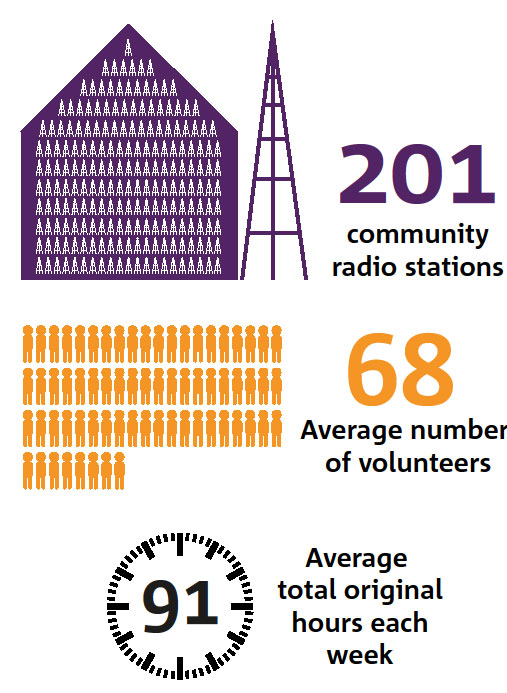
The milestone comes as the first community radio station to hit the airwaves – The Eye in Melton Mowbray – nears its seven-year anniversary.Since Ofcom awarded the first community radio licence in 2004, new stations have launched in areas all over the UK – from inner London to Orkney – each serving a particular community’s needs.Community radio stations typically cover small areas, generally up to 5km, and are run on a not-for-profit basis. They reflect a diverse mix of cultures and interests – some catering for whole communities, while others focus on particular areas of interest.Ed Richards, Ofcom’s Chief Executive, said: “Community radio is thriving and helping to bring together local communities across the UK.“With more than 200 stations on air, community radio is enabling thousands of people to have a voice and help serve the needs of their local area.”Community radio stations reflect the variety of cultures, demographics and tastes in the UK:Kane FM. Based in Guildford, Surrey, Kane FM serves young people aged 15-39 focusing on and supporting independent urban music and showcasing local artists. The station works to support services and agencies dedicated to reducing inequality and social exclusion.Garrison FM. Six community stations serving British Army garrisons in Great Britain, including Aldershot, Catterick and Edinburgh. The Garrison FM stations provide welfare and communication services to soldiers and civilians living and working within the army community.The Eye. The first community radio station to start broadcasting, 103 The Eye has been serving residents of Melton Mowbray since November 2005.Christine Slomkowska, Managing Director of 103 The Eye, said: “Being a community radio station means 103 The Eye can keep the localness in radio and provide an information and entertainment service for our area which was under-served by other stations.“Over the last seven years we’ve given a wide range of people the opportunity to produce and present radio programmes, offering training and airtime opportunities which have led to careers in the media and progression within the music industry.”Latest stations on airSince the first station went live seven years ago, a new community radio station has launched, on average, every 13 days.SFM and Garrison FM Blandford are the latest stations to begin broadcasting. SFM provides the residents of Sittingbourne, Kent, with a local music and speech service.Garrison FM Blandford in Dorset is the latest community radio station to serve a British Army garrison in Great Britain.Mark Page, Managing Director Garrison Radio, said: “Blandford is a very close community of soldiers and families and through Garrison FM we can bring Army news and information specific to them. Going around Blandford Garrison, hearing the station on in offices and finding people to talk to about it is amazing.”Community benefitsAs well as providing unique content, community radio stations bring wider benefits to local people. These include offering training and work experience opportunities and providing a voice to those, such as older people or speakers of minority languages, who may find it harder to access the media.Kane FM, based in Guildford, was a pirate radio station but applied for a community radio station when new licences became available in the area. It wanted to become a community station so the people involved could start working with disadvantaged groups. Kane FM has an advisory panel consisting of local organisations such as the Police, Surrey County Council, Surrey Arts and Youth Justice.Simon Foster, Director of Kane FM, said: “Since becoming a community radio station, Kane FM now has 100 independent local musicians and artists creating content and weekly shows, as well as over 130 volunteers.“We want to turn around those people at the fringes of society and give them new skills and a sense of belonging; to strive forward and achieve for those who may otherwise be dismissed or ignored.”VolunteersAll community radio stations involve volunteers working in various jobs, including presenters and producers.The average station has over 68 volunteers each year, who in total give more than 1,000 hours of their time a month to these community services. The average station broadcasts 91 hours of original content every week, 84 of which are live. Ofcom estimates that volunteers contribute more than 2 million hours per year to community radio.All stations offer some form of training to their volunteers. Phoenix Radio in Halifax, for example, developed a specific radio-based training scheme for young people aged 16-25, while Desi Radio in Southall, West London, has a dedicated centre providing training for radio presenting.In total, almost half of all stations (47%) are aimed at a general audience in towns or rural communities, with 15% broadcasting to general audiences in urban areas. However, a significant proportion target specific groups such as young people (10%), minority ethnic groups (13%) or military personnel (4%).The Community Radio Order 2004 paved the way for Ofcom to license these new types of radio stations. Ofcom has since awarded licences to 259 community radio services.Soo Williams, Community Radio Manager at Ofcom, said: “We are now into the third round of community radio licensing and there continues to be strong demand to set up new stations from all corners of the country.”
24 novembre 2011
Community Radio UK, 10 milioni di sterline per un rilevante profitto sociale


07 settembre 2011
Radiomarina 1071 kHz, le prime immagini
05 aprile 2011
OFCOM: iniziative contro i pirati e per nuove radio comunitarie. Ma bugie su Powerline
19 dicembre 2010
USA: le radio comunitarie "low power" sono legge

Press Release of Senator CantwellCantwell Shepherds Unanimous Senate Passage of Low Power FM BillLegislation will allow FCC to license new community radio stationsSaturday, December 18, 2010WASHINGTON, D.C. – Today, U.S. Senator Maria Cantwell (D-WA) shepherded the unanimous Senate passage of the Local Community Radio Act, which will allow a multitude of low power FM (LPFM) stations to obtain broadcasting licenses in communities of all sizes across the country. Currently, the Federal Communications Commission's (FCC) technical rules limit the number of low power FM stations that can practically be licensed in urban and suburban areas. The Act changes these rules, allowing for more LPFM stations to be licensed nationwide, but doing so in a manner that addresses the interference concerns of full-service FM radio stations.“Today is a day for community radio to celebrate and for America to celebrate community radio. Low power FM stations allow for more viewpoints, community-centered news, and a variety of alternative programming,” said Senator Cantwell. “For far too long, this legislation has been held up, preventing dozens of stations in my home state of Washington from applying for local low power licenses. I am pleased that more individuals can now add their voices to the airwaves.”Cantwell, along with Senator John McCain (R-AZ), sponsored the original Senate version of the legislation. Cantwell has introduced legislation promoting low power FM stations during the last three Congresses.Low Power FM radio stations operate on the FM radio spectrum and provide an affordable alternative to community groups unable to obtain expensive full-power radio station licenses on very scarce broadcast spectrum. With a broadcast range of about 3.5 miles, community groups can provide listeners with localized content and an alternative broadcast outlet.Full bill text can be found here.
15 novembre 2010
Roma: lo sviluppo del Terzo mondo attraverso la radio
Cooperazione e sviluppo, la Radio protagonistaConvegno a Roma (sede Fnsi) il 19 novembre sul tema dell'emittenza radiofonica come soggetto importante della Cooperazione allo sviluppo anche nelle emergenze umanitarie. Il progetto "Dai voce a una radio": un sostegno tecnico, professionale e formativo alle emittenti dei paesi del Terzo MondoLa radio come protagonista dello sviluppo dei media nel sud del mondo. Lo strumento più diretto, più vicino alla gente, per certi versi più semplice, può davvero avere un ruolo fondamentale nella crescita sociale, economica e della democrazia nei paesi che stanno uscendo dall'arretratezza e, spesso, hanno conosciuto o conoscono il peso di regimi autoritari. Questa realtà e le relative occasioni d'intervento sono diventati, a poco a poco, uno dei principali filoni dell'attività di Media Aid che dedica il suo volontariato ai temi dell'informazione. Dal nostro convegno dell'anno scorso, la questione è emersa con chiarezza: le radio, soprattutto quelle comunitarie, possono crescere e possono trovare sostegno tecnico, professionale e formativo nelle iniziative di organizzazioni del mondo sviluppato come, appunto, Media Aid e come tante altre.Così, a distanza di un anno, Media Aid rilancia il problema, in collaborazione con Link 20007, attraverso un altro convegno (venerdì 19 novembre nella sede Fns, corso Vittorio Emanuele 349, Roma, col patrocinio di Fnsi e Usigrai) nel quale, però, oltre ad approfondire il tema del ruolo della radio nella cooperazione allo sviluppo e nelle emergenze umanitarie, si punta a dare subito risposte concrete.IL PROGRAMMA DEL CONVEGNOL'idea è chiara fin dal titolo della seconda parte dell'incontro: "Dai voce a una radio". Protagoniste alcune emittenti italiane (RadioArticolo1, Radio Capital e Radio 3 Rai) che si sono rese disponibili e interessate a un rapporto privilegiato con alcune radio del Terzo Mondo con l'obiettivo di aiutarle nella loro crescita attraverso un supporto professionale, tecnico e formativo. Ma le emittenti italiane sono anche interessate a fare da ponte per rilanciarne la voce, le iniziative, le parole e la musica: in una frase, per far conoscere le radio "gemellate" anche da questa parte del mondo. L'obiettivo del convegno è definire il progetto nei particolari e gettare le basi di una rete che possa allargare il discorso e i "gemellaggi" a tante altre emittenti. Si discuterà dunque, di come attuare (con quali strumenti, quali risorse, quali "protocolli" formativi) il progetto a partire anche dalla definizione delle reali esigenze delle emittenti in crescita.Il convegno si svolgerà in due parti. Dopo il saluto di Fnsi e Usigrai, si entrerà nel merito del tema generale: "Cooperazione allo sviluppo e Emergenze umanitarie: quale ruolo per la radio?" con l'obiettivo di definire le linee di intervento possibili e i progetti di istituzioni e media. Modererà Anna Donato, presidente di Media Aid Onlus. Sono previsti gli interventi delle istituzioni: Stefano Taliani (Capo ufficio emergenze della Dirrezione Cooperazione e Sviluppo del Ministero degli Esteri) e Adelaide Frabotta (vicesegretario generale Commissione Italiana per l'Unesco).Seguiranno, moderati da Nino Sergi (del direttivo Link 2007), gli interventi degli operatori dei media: Carlo Romeo (segretariato sociale Rai), Francesco Diasio (Amac Europa), Barbara Gruden (giornalista Gr Rai), Valentina Monti (regista videdocumentari), Silvia Pochettino (direttore della rivista "Volontari per lo sviluppo").Dalle 12, Cristina Loglio, coordinatrice del progetto per Media Aid, illustrerà il progetto "Dai voce a una radio". Nel dibattito prenderanno la parola i rappresentanti delle emittenti che hanno già dato la loro disponibilità ad esserne protagonisti.
09 novembre 2010
La crisi finanziaria di una radio "listener supported"


Pacifica Radio Lays off the Entire Staff of KPFA’s Morning ShowThe Program is the Station’s Biggest Fund RaiserBERKELEY - November 9 - Arlene Engelhardt, the Executive Director of Pacifica Radio, yesterday dismissed the entire staff of the KPFA Morning Show and ordered today’s program be taken off the air. The Morning Show is KPFA’s most popular locally produced program—as well as the station’s single biggest source of fund raising revenue.The Morning Show is the only program targeted for cuts by Engelhardt. The layoffs violate the seniority protections in KPFA's union contract and appear to be retaliatory against staff who have been critics of Pacifica. In September, three members of the Pacifica National Board drew up a list of KPFA workers they wanted laid off. The staffers at the Morning Show were on that list.The program’s staff–Aimee Allison, Brian Edwards-Tiekert, Laura Prives, and Esther Manilla–were told that yesterday was their last day on the air, and that starting today, the Morning Show would be replaced by programming from a radio station in Los Angeles. KPFA 94.1 FM is America’s first listener-sponsored radio station.“The Morning Show has the most listeners and raises the most money of any local KPFA program,” says Sasha Lilley, co-host of KPFA’s Against the Grain. “By cutting the Morning Show, Pacifica is virtually guaranteeing that more layoffs will follow, as the station’s fundraising and listenership shrinks.”The layoffs come in spite of a proposal by the union representing KPFA’s paid staff for a “sustainable budget” that, along with making voluntary layoff packages available, would have eliminated the need for all involuntary layoffs of KPFA staff. On Friday, the union filed an Unfair Labor Practices charge with the National Labor Relations Board, accusing Pacifica management of unlawfully failing to negotiate alternatives to layoffs, as required by the station’s union contract. Communications Workers of America Local 9415 charges Pacifica with violating its obligation to bargain in good faith with the union.The Pacifica Radio network is an independent, non-profit organization that operates five radio stations: KPFA in Berkeley, KPFK in Los Angeles, WBAI in New York City, KPFT in Houston, and WPFW in Washington, D.C. In 1999, a struggle between KPFA and Pacifica's National Office became a national and international news story and 10,000 people marched through the streets of Berkeley to save their station.For more information about the labor conflict at KPFA, go to
06 ottobre 2010
SIAE: sparisce la categoria delle Web radio "personali"


07 settembre 2010
Il missionario della radio in Togo su Radio 1 e Rete Due

17 maggio 2010
La radio "dal basso" della Grassroots Radio Coalition
Published on Sunday, May 16, 2010 by Raw Story‘There is a Narrative that’s Missing’ Laura Flanders Tells Grassroots Radio Gatheringby Gavin DahlTelevision and radio host Laura Flanders ripped into what she called "the all-about the-money media" and encouraged 150 radio enthusiasts to work harder at storytelling in a keynote address to the Grassroots Radio Conference May 14.Calling the Obama administration "a veneer of new backed up by the same old same old," Flanders took shots across the political spectrum garnering bursts of applause with her characteristic mix of humor and breaking news.She stressed that there is a failure in the media to report on important news from the perspective of the public, and insisted that those stories can be told better at the grassroots level. "There is a narrative that's missing," Flanders insisted. "Rupert Murdoch bought the narrative when he paid $5 billion for Wall Street Journal... And we are being played and played and played and played."Her most recent book Blue Grit looked at an upsurge in grassroots activism during the previous presidential administration. She said Friday night that there was more progressive politics than anything reflected in the Democratic party. On keeping President Obama accountable to those who elected him she said, "We're not doing any better job than the civilians of Afghanistan."She broke the news of Governor Arnold Schwarzenegger proposing the elimination of $12 billion in California welfare spending, which she said would affect 1.4 million people. She talked about the controversial new climate bill, the 27 drilling licenses approved since the BP oil spill in the Gulf of Mexico and said sometimes Congressional hearings can make good viewing on CSPAN.However, Flanders exclaimed, "It's not Congressional hearings we need into Massey or BP or Goldman Sachs. We need court hearings. We need some of these people taken away in chains."Clearly, Flanders enjoyed the crowd's reactions to her key points, and she made some statements that are more politically radical than her image, including encouraging one pirate radio advocate that California's budget crisis could limit enforcement. However, her most outrageous statement came up near the end of the speech."Why don't you do what Oklahoma wants to do with people who want abortions?" she asked rhetorically. "You can be strapped to a gurney and required to listen to the heartbeat of your fetus, as if this had never occurred to you before, that there was a heartbeat there. What if we strapped some derivatives traders into those stirrups, made them put on that gown, and listen to the high-pitched squeals of people who can't pay their mortgages? What if we strapped the folks who are responsible at British Petroleum and Halliburton and the Interior Secretary and forced them to listen to the pleas of people who have lost their entire livelihoods on the Gulf Coast?"The crowd of volunteers and staff for commercial-free, independent radio stations around the continent cheered her on, enjoying the mood in the rundown old movie theater in downtown Garberville, CA.Passion is not proprietaryHosted by the Southern Humboldt County community radio station KMUD, the fifteenth annual Grassroots Radio Conference brought together hundreds of broadcast enthusiasts for a weekend of workshops and skill-shares. Topics included community journalism, legal compliance, technical wizardry, and social justice.Maka Munoz of Palabra Radio and Ana Martina of El Otro Lado began their workshop on building a network for immigrant-rights radio content by asking attendees to share stories from home. The group of two dozen heard about inaccurate media portrayals, a controversial gang injunction, widespread profiling, and the separation of families by detention and deportation. Representatives from 15 immigrant radio projects will converge at the upcoming Allied Media Conference (June 17-20 in Detroit).Pete Tridish and Maggie Avener of Prometheus Radio offered insight into how the airwaves are being reshaped in response to new technologies, and worked with the attendees to strategize about ensuring the grassroots has a place on tomorrow's spectrum. Rip Robbins of KSVR Mt Vernon, WA and Elizabeth Robinson KCSB Santa Barbara, CA supplied information on limits to on-air expression. Low-budget stations have to be careful to avoid sanctions from the FCC, the IRS or the law.Compliance with radio royalty structures supporting musicians were explained by Clay Leander of KPFA Berkeley and attorney Michael Couzens. SoundExchange collects royalties for labels and artists from webcasters. Congress has been lobbied hard about the Performance Rights Act, which seeks to force broadcasters to pay royalties to performers, not just songwriters and copyright holders.David Pakman explained his production process, syndication, outreach, marketing and value added content. He is host and producer of Midweek Politics, a political talk show with 40 TV affiliates and 40 radio affiliates. He Dan Roberts has produced The Shortwave Report off-the-grid since 1997. He demonstrated the basic equipment he uses to share international perspectives gleaned from shortwave transmissions. His program airs on dozens of community radio affiliates in North America. Both programs are made available free online.Govinda Dalton and Christina Aanestad of Mendocino County-based Earthcycles.net showed off their veggie oil-powered remote broadcasting studio. The converted school bus is home to studio equipment, LPFM antenna, satellite dish for web streaming uplink, wind turbine, solar panels, even a wood stove inside the bus. KMUD also tours inside their emergency-response broadcast trailer, which was parked outside conference headquarters all weekend.Claude Marks of the Freedom Archives demonstrated projects that re-purpose historical archives of community radio and social justice movements. "Healthy programming has to have roots," he said. Community radio reporters were embedded in the movements of the fifties, sixties and seventies, not with the military. "It's a subjugated history," Marks says. "The movements were attacked. So last year we anticipated the repression of Black Panthers by producing our documentary Legacy of Torture and that meant that the press couldn't just run with the cops' story."Cointelpro 101, the new film by the Freedom Archives, will debut at the US Social Forum (June 22-26 in Detroit). Marks is wary of society's short-term memory, seeking to protect the stories of uprisings and dissidence from misinformed representations. And he also hopes to inspire new generations of community journalists to learn of traditions of resistance and have the courage to risk getting into the line of fire to tell important stories. He says, "The history isn't all made in the studio or over the phone."
12 febbraio 2010
Lo sforzo per riportare la normalità nell'etere di Haïti
On our last day, I also went to visit the nongovernmental organization called Inveneo. Inveneo is responding to the Haiti earthquake with much needed communications infrastructure for NGOs, such as Save the Children, Care, etc. Inveneo has deployed long-distance WiFi links across Port-au-Prince bringing high-speed Internet access - critical communication capacity - to relief agencies making a difference in Haitian lives. Inveneo, working with NetHope agencies, has now linked ten relief organizations in the Port-au-Prince. Inveneo is working with the Haitian ICT community to find immediate ways for them to participate in the reconstruction of their country.
I tried to meet up with the Telecom sans Frontieres crews who are providing free international calls in many of the refugee camps around Port-au-Prince (and now outside the city as well), but due to tremendously difficult logistical issues, I was not able to meet up with them. I did, however, chat with their staff about the wonderful work that they are doing in Haiti – as the very first telecom responder in Haiti they have played a key role in connecting the victims of the earthquake with loved ones around the world. You can see more about what they are doing in Haiti at TSF’s website.
I want to tell you about a special need in Haiti now – the radio and TV stations. The earthquake affected all of Haiti’s communications infrastructure, but the damage to radio and TV stations has been particularly debilitating because they are normally staffed 24/7 so the proportional loss of life and building and equipment damage was enormous. The impact of the earthquake has strained the ability to spread information about humanitarian relief and other messages, not to mention music and recreational programming. A good thing about broadcasting is that it can reach so many people at once – when it’s working. Now more than ever, radio and TV is a critical source of information for the people of Haiti – regarding location of food and water distribution, medical services, shelter, weather, etc. By the time we left, only six of 18 TV licensees were on the air, and their operations were intermittent. The two licensed AM radio stations were off the air because they couldn’t afford the fuel needed to run the generators that would power their transmitters. Of the 40 licensed FM stations, 30 were on the air, with a few able to operate between 12-16 hours per day. Damaged facilities and equipment, limited fuel and lack of advertising revenue are really hurting the broadcasters in Haiti now.
To help improve this situation, at the FCC, we are working with U.S. broadcast organizations to facilitate any assistance possible for the Haitian broadcasters – from equipment to programming. There is an organization on the ground in Haiti called the Internews Network. Internews is an international media development organization whose mission is to empower local media worldwide to give people needed news and information. It has responded to other disasters around the world and is in Haiti trying to help improve the broadcasting situation. At the FCC, we’re also exploring ideas to see what could be done to support Haiti’s broadcast media.
30 gennaio 2010
Ad Amburgo c'è una stazione; in onde corte
E' un fenomeno per marginali nostalgici o può diventare un modello anche in altre nazioni? Volendo essere cinici e realistici, è difficile pensare a una diffusione su larga scala di questo tipo di stazioni. Ma pensiamola per una volta in una chiave non industriale, bensì utilitaristica, ad hoc. Ci sono in Europa e nel mondo numerose realtà urbanizzate che potrebbero mettere a frutto un medium diffusivo come questo, offrendo spazi a istituzioni pubbliche e associazioni private che non troverebbero mai posto nello spettro delle radiofrequenze più convenzionali. In una banda come quella dei 49 metri delle HF potrebbero trovare posto voci del tutto tagliate fuori dai meccanismi regolamentari classici - sempre ovviamente che le voci in questioni vogliano perseguire, per farsi sentire, un approccio diffusivo "broadcast". Con tutta probabilità il costo di avviamento e mantenimento di una stazione radio HF non sarebbe competitivo con uno stream su Web. Ma offrirebbe parecchi vantaggi in termini di fruibilità. A me vengono in mente le diverse comunità straniere di Milano e contemporaneamente penso al bassissimo costo di un moderno ricevitore radio tascabile di fabbricazione cinese: per determinate categorie di ascoltatori a basso reddito quale sarebbe la soluzione più semplice, il Web o le onde radio? Se la normativa facilitasse la creazione di una stazione a onde corte, con un occhio alle possibili evoluzioni verso le modulazioni digitali, non escluderei l'interesse da parte di singoli e organizzazioni nei confronti di una modalità le cui soglie di accessibilità e fattibilità sono davvero molto basse. Le onde corte sono un mezzo obsoleto, inutile farsi illusioni. Ma la voglia e la necessità di comunicare sono fortunatamente ancora in auge. Perché non esplorare, come hanno fatto ad Amburgo, certe finestre di opportunità?
Shortwave Gains Low-Power Interest
by Thomas Völkner, 01.29.2010HAMBURG, Germany — Over the past two decades, governments in many countries have deregulated transmission services. Today, private enterprises own and operate even large shortwave sites once in the hands of postal and telecommunications authorities.
But it is not only the big power houses.
In Germany, an amateur radio operator bought transmitters, an antenna plant and other equipment from the police and the armed forces, leased a large part of a former utility radio site and is now offering low-power analog transmission services to a certain range of radio stations.
Hamburger Lokalradio (HLR) is one of currently two stations using a small-scale, low-power shortwave service.
Active on FM for 11 years with a mix of high-quality speech programs and specialized music shows, this non-commercial station has repeatedly reached out to listeners beyond the Hamburg city borders. Besides working together with other FM stations and public-access channels in the neighboring state of Schleswig-Holstein, HLR rents airtime on a high-power shortwave transmitter from TDF Group subsidiary Media Broadcast and has a weekly slot on WRN Deutsch, the German language service operated by the London-based transmission-services provider WRN.
Why an international branch for a station that brands itself as “local radio”? “We are licensed as a nationwide special-interest broadcaster focusing on cultural topics,” said HLR Editor-in-Chief Michael Kittner. “This means we can have our programs aired all across Germany and even abroad. Of course, as a Hamburg-based station, our main emphasis is on our own city.”
Traveling without a visa
But why using shortwave, especially at a time when Germany’s own international radio, Deutsche Welle, is reducing its output on the analog HF bands? “Well, for me, listening to programs on shortwave is like traveling without a visa,” said Kittner. In his experience — both as a radio host receiving feedback from listeners and as a listener himself — shortwave listening is signified by a higher attention to the content, compared to FM. “This is why we particularly relay our speech-based programs internationally.”
One may add, the station’s claim “Total lokal und weltoffen” (completely local as well as open to the world) gains a special meaning from the international distribution.
In December 2009, HLR started conducting test transmissions on the newly acquired frequency of 5980 kHz with a power of just 1 kW. The tests are usually two hours per day in duration, going up to six hours per day over the Christmas period.
They consist of shows from the station’s archives, plus a cross-section of current productions. The entire content is re-edited, given a new set of continuity announcements for an international audience and then fed via the Internet to the transmitter site. That site is located roughly 400 kilometers (about 250 miles) away in Kall, a small village in the rural Eifel area of Nordrhein-Westfalen. It was once used as a regional police compound, complete with various buildings, underground bunkers and an antenna field.
Avid amateur radio operator and HF engineer Burkhard Baumgartner realized the potentials of the site and managed to lease the transmitter bunker as well as the aerial masts and other equipment. With the help of two friends, he refurbished a handful of SK1 transmitters, constructed in the 1960s and ’70s by Rohde & Schwarz, with a power of up to 20 kW.
Baumgartner’s basic aim is to preserve the knowledge about analog broadcasting equipment for the future generations of HF engineers. “Of course all transmitters with accessories are in a fully operational condition and are used in a professional manner day after day,” he said.
At first, it was just Baumgartner himself who used the equipment for amateur radio purposes. However, two years ago he entered a new stage as a non-commercial service provider for Radio 700, a broadcaster from the nearby city of Euskirchen — a station that was fully licensed but lacking a proper FM frequency.
The station applied for permission to use 6005 kHz in the 49-meter band, the frequency used until 2007 by RIAS Berlin and its successor Deutschlandradio. After completing a full metrological check, the German federal frequency regulatory body, or Bundesnetzagentur, issued a shortwave license to Radio 700.
The station started its service in April 2008. It can be heard in many parts of Germany and in neighboring countries. “We usually experience a dead zone of 100 to 200 kilometers [about 60–120 miles] around Kall,” said Baumgartner. “But conditions and signals on neighboring frequencies permitting, people can pick up the our signal within several hundred of kilometers distance.”
Lots of listeners’ replies arrived from Scandinavia and Eastern Europe, and it is expected that Hamburger Lokalradio will reach a similar target area. It is still to be seen from the feedback as well as own observations how many hours per day HLR will be on the air after the test period.
Still, there are even more new projects pending for Michael Kittner and his colleagues. In early 2010, they plan to launch a daily six-hour loop of cultural programs on a digital cable channel in Hamburg. A new streaming audio solution for the station’s Web site is also in the pipeline, “And then let’s see if we get the chance to transmit on DVB-T as well,” Kittner said.
Thomas Völkner is a Berlin-based freelance writer and radio producer. Before he was editor-in-chief at Radioropa Hörbuch and presentation manager at WRN.
20 dicembre 2009
Ora alle FM "low power" manca solo l'ok del Senato USA
Le radio FM a bassa potenza godono di un regime di autorizzazione più rilassato rispetto alle stazioni "Full Power" e soprattutto costano molto meno, in termini di equipaggiamento e bolletta elettrica. E' sufficiente una somma tra i 2 e i 5 mila dollari per far partire una stazione. Questa tipologia di stazioni era stata approvata nel 2000, ma subito dopo una legge fatta passare un po' surrettiziamente dalle associazioni dei grandi broadcaster, impose un limite "spaziale" per cui una LPFM non poteva operare a meno di 600 kHz di distanza da una Full Power per non "creare interferenze". Una classica istanza di lupi disturbati da agnelli.
Nel 2003 un celebre rapporto commissionato dalla FCC, il rapporto MITRE, dal nome di un laboratorio no-profit che si occupa di test e valutazioni nell'ambito di progetti a finanziamento federale e militare (MITRE, nata nel 1958 ebbe un ruolo in ARPAnet e in Tymnet, le radici di Internet) concluse che il rischio non c'era, le LPFM avrebbero potuto trasmettere anche senza tutti questi limiti.
Dal rapporto MITRE sono trascorsi sei anni. Solo nel 2009 si è ricostituito un clima favorevole a una revisione delle regole che nel 2000 avevano in pratica imbavagliato sul nascere le piccole stazioni locali che scuole, istituzioni, ospedali, associazioni e comunità varie potrebbero costituire. Presentata in Commissione Commercio Industria nel febbraio di quest'anno, la legge ha subito una accelerazione a settembre e ora ha conquistato, per "voice vote", in pratica per alzata di mano, l'accesso all'ultimo passo prima della definitiva entrata in vigore. Restano perplessi i grandi broadcaster e tutti coloro che preferirebbero utilizzare lo spettro FM per attivare ripetitori che allarghino il bacino di ascolto, specialmente delle stazioni in onde medie. Tra gli oppositori del progetto c'erano anche il NAB e NPR, che tuttavia non si sono più opposti al passaggio del testo alla Camera.
Per gli attivisti, il Local Radio Act H.R. 1147 - una iniziativa politicamente bi-partizan - è soprattutto un modo per "dar voce a chi non ha voce" e favorire, per esempio, i giovani musicisti. In lista d'attesa, secondo l'associazione FreePress, che appoggia la nuova legge, ci sono migliaia di piccole stazioni che potrebbero finalmente iniziare a trasmettere., dopo le 800 autorizzate in passato. Quello che segue è il comunicato di FreePress, per un riassunto molto dettagliato ho trovato questo post sul blog MediaIsland.
Date: December 17, 2009
WASHINGTON -- The U.S. House of Representatives voted on Wednesday to open the airwaves to hundreds of new Low Power FM radio stations across America. The Local Community Radio Act (HR 1147), introduced by Reps. Mike Doyle (D-Penn.) and Lee Terry (R-Neb.) and supported by more than 80 co-sponsors in the House, now awaits a vote by the full Senate.
Candace Clement, program coordinator at Free Press, made the following statement:
"Today’s House victory is an important step in the decade-long fight to build and diversify local radio. This legislation is about amplifying local voices and expanding a bottom-up, people-powered medium to counteract rampant media consolidation. Low Power FM stations provide new opportunities for independent and diverse voices on the airwaves and outlets for truly local information and perspectives.
"We commend Representatives Doyle and Terry for their hard work and leadership on this issue, as well as the Prometheus Radio Project and LPFM advocates across the country who have built a movement to bring better local radio to the American people. We look forward to Senate passage of this important legislation and to President Obama signing this bill into law."
12 novembre 2009
Media interculturali: meeting a Bologna
Bologna, 13 - 14 novembre 2009“GIOVANI AD ALT(r)A VOCE”, IL MEETING DEI MEDIA MULTICULTURALICOSPE, assieme alla rete MIER (Media Interculturali Emilia Romagna), il Comune di Reggio Emilia, il centro Interculturale di Mondinsieme e la rete ToghethER, organizza il meeting “Giovani ad alt(r)a voce”, con il finanziamento della Regione Emilia Romagna e il patrocinio del Comune di Bologna.
“Giovani ad alt(r)a voce” si terrà a Bologna, venerdì 13 e sabato 14 novembre 2009, presso il Palazzo D’ Accursio, in P.zza Maggiore. Al centro del meeting i media interculturali e i giovani: risorse, idee, sguardi da un territorio che cambia e parla con voci e accenti nuovi. Non solo parole, immagini e musiche della società interculturale: si partirà coi giovani delle realtà associative interculturali, protagonisti con le loro esperienze e le loro proposte per una nuova cittadinanza plurale.
A seguire, giovani reporter di una redazione interculturale animeranno una trasmissione TV in diretta con esperti, giornalisti, rappresentanti di organismi locali, nazionali e internazionali.
29 ottobre 2009
Radio comunitarie, uno speciale della rivista EPTIC
Nova edição da Revista Eptic debate Rádios Comunitárias
O terceiro número da Revista Eptic On Line do ano de 2009 traz um dossiê especial sobre as rádios livres e comunitárias a partir de análises de experiências brasileiras, latino-americanas, francesas e uma africana. Os estudos foram realizados por experientes pesquisadores brasileiros na temática e contou com a participação especial de um grupo de estudiosos franceses que tem se dedicado ao assunto nos últimos anos.
O objetivo da nova edição da Revista Eptic On Line é contribuir para o debate sobre as rádios livres e comunitárias, ou associativas como são denominadas na França, por meio de análises que mostram a importância desses meios para a democracia, além estudá-las a partir das relações de poder em que estão inseridas. No Brasil, a edição que antecede a realização da primeira Conferência Nacional de Comunicação, espera dar sua contribuição e colocar novos elementos para o debate da temática.
Nesse sentido, o número atual conta também com uma entrevista com Raquel Paiva, professora do Programa de Pós-graduação em Comunicação da Universidade Federal do Rio de Janeiro (ECO/UFRJ) e fundadora do Laboratório de Estudos em Comunicação Comunitária (LECC), sobre o papel das rádios comunitárias enquanto espaços contra-hegemônicos.
Além disso, a Revista dispõe de três relatos de pesquisa que tratam, de maneira geral, sobre o impacto do desenvolvimento das tecnologias da comunicação e da informação na sociedade, e de uma resenha do livro “Rádios comunitárias no Brasil e na França: desafios da esfera pública contemporânea”, de autoria da professora Sayonara Leal, que será lançado ainda esse ano.
Clique aqui e confira o conteúdo completo da última edição.
Especial Rádio Comunitária, política e cultura: reflexões teóricas e desafios metodológicos
El oyente comprometido: teorías y preceptos fundadores de las radios participativas en América Latina.
Isabel GuglielmoneRádios Livres e Comunitárias, Legislação e Educomunicação.
Cicília M.Krohling PeruzzoDiversidade cultural, cidadania e esfera pública: um olhar sobre as rádios comunitárias no Brasil
Sayonara LealDiversité culturelle, interculturalité et radios associatives en France, l’exemple Bordelais.
La stratification générationnelles de la radio en France.
Jean-Jacques Cheval;
Sheila Vanessa Sevilla Zeballos
Hervé Glevare
Michel Pinet
La radiodiffusion a Madagascar et son cadre reglementaire: les cas de la «RNM» Et des stations locales privees
Solange Razafimbelo-Bruyeron
13 maggio 2009
Londra, premiata la radio dietro le sbarre
Ale Colombo (grazie, Ale) mi ha fatto un grande favore inviandomi il link all'articolo del Guardian di ieri con la notizia relativa al Sony Radio Academy Awards, che ogni anno premia, in diverse categorie, la migliore produzione radiofonica britannica. Con una certa sorpresa, la cerimonia finale dell'edizione 2009 del concorso ha visto assegnare ben quattro riconoscimenti (The Speech Award; The Listener Participation Award; The Interview Award; e The Community Award) a Electric Radio Brixton, una emittente che "cattura" - letteralmente - i suoi ascoltatori.ERB trasmette infatti per gli 800 "inmates", i reclusi della prigione londinese di Brixton. La stazione ha inaugurato le sue trasmissioni circa un anno fa ed è uno dei progetti promossi dalla Prison Radio Association, una organizzazione benefica che affianca le varie amministrazioni carcerarie britanniche nell'allestimento di piccole stazioni low power, mettendosi a disposizione anche per formare lo staff dello studio e addestrarlo nelle tecniche delle interviste, della conduzione e della regia radiofonica.
Electric Radio Brixton ha battuto concorrenti assai più blasonati e ha fatto discutere molto i giornali locali, che hanno dedicato ampio spazio a una bella storia, una delle tante che dovrebbe farci riflettere vista la penosa situazione in cui versano molte prigioni italiane (e in un clima sempre più forcaiolo che vorrebbe le carceri sempre più affollate e oppressive). Ricevere la giusta punizione per i reati commessi non dovrebbe implicare un trattamento disumano, anche perché l'incarcerazione dovrebbe servire proprio a far percepire la differenza tra una collettività che segue e rispetta le regole e un'azione consciamente lesiva di questa collettività. E invece il carcere in Italia coincide troppo spesso con il punto di innesco di una violenta spirale di crimine, vendetta, emarginazione e nuovi reati, dove il significato del termine riabilitazione va completamente, anzi colpevolmente perduto.
BBC Radio 4 ha dedicato una parte della trasmissione mattutina Today dell'11 maggio a una serie di interviste sul caso di ERB e un lungo articolo che fa il paio con quello del Guardian segnalatomi da Ale. Ma da vedere è soprattutto il sito della Prison Radio Association, dove si trovano molte fotografie e clip audio, come questo augurio di natale rivolto a chi, uscendo, ritroverà la voglia di celebrarlo . Il programma che ha vinto il premio per la migliore intervista riguarda la conversazione di un giornalista di ERB con Jonathan Aitken, ministro britannico condannato a 18 mesi (sette dei quali scontati in cella) per aver cercato di manipolare i testimoni del suo processo per corruzione.
.jpg)