Visualizzazione post con etichetta radio online. Mostra tutti i post

25 gennaio 2011

BBC Online taglia e toglie la radio a iPlayer


Se ancora non si sa nulla sulle nuove strategie Web di Mamma RAI né sui progetti di reintegrazione del suo spin-off digitale RAI Net, la stampa britannica dà ampio spazio al piano di revisione della strategia online della BBC. Dopo l'annuncio di una spietata politica di riduzione dei costi, in questi giorni i tagli sono stati esplicitati. Finanziamenti tagliati di un quarto e 360 posti di lavoro eliminati da qui a due o tre anni. La presenza online della BBC viene riorganizzata in dieci prodotti suddivisi in cinque aree generali.
Moltissime, circa 200, le sezioni del sito che verranno chiuse (secondo Wired sparirà anche la leggendaria Hitchhiker's Guide to the Galaxy ideata dal compianto Douglas Adams).
Ma la parte che ci interessa maggiormente riguarda iPlayer, il programma che consente di accedere via Web, in streaming e on demand, all'intera offerta televisiva e radiofonica della Beeb. Marketing Week riprende le ultime dichiarazioni del direttore Future media and technology, Erik Huggers (ultime perché Huggers oggi lascia la BBC per approdare alla divisione Digital Home di Intel) e annuncia che iPlayer si focalizzerà sulla televisione, perdendo i programmi di BBC Radio. Una intervista audio a Huggers è stata pubblicata su uno dei blog del Financial Times, il Tech Hub. Il piano strategico della BBC Online appena approvato dal BBC Trust è disponibile in pdf a questo indirizzo.
Gli sforzi si concentreranno piuttosto sulla joint venture con il mondo della radio commerciale per il lancio del Radioplayer, un progetto di cui ho parlato già diverse volte. Qui di seguito potete seguire l'intervista di Jonathan Mark, di Critical Distance, noto consulente mediatico internazionale a Michael Hill, responsabile dell'aggregatore Radioplayer, la cui ambizione è raccogliere *tutti* gli stream delle emittenti britanniche, dalla BBC alle più piccole locali, offrendo anche una guida alla programmazione. Il lancio ufficiale era previsto in queste settimane, forse le notizie su iPlayer faranno da stimolo.

24 maggio 2010

Due studi sul consumo di radio online

La National Broadcasters Association americana analizza due recenti studi sul consumo online di programmi radiofonici, le ricerche presentatate da Arbitron/Edison Reesearch (Digital Platform and the Future of radio, di cui ho già parlato) e Radio Futures 2010 di Vision Critical, una società newyorkese. Il primo conferma l'enorme popolarità dei mezzi online, rivelando tra l'altro che il mezzo con il maggiore impatto sulla vita degli americani è ormai il telefonino, seguito dal televisore, da Internet e solo al quarto posto dalla radio.
Sarebbero ormai 43 milioni gli americani che hanno una frequentazione della radio su Internet su base quotidiana nell'arco della settimana.
Vision Critical cerca di andare più a fondo in questa nuova abitudine e scopre che mentre in Canada e Regno Unito si va su Internet per ascoltare la radio convenzionale, gli americani tendono a privilegiare molto l'offerta "solo Web" di Pandora e compagni. I due studi possono essere prelevati online ai seguenti indirizzi: Arbitron/Edison Study e Vision Critical.

Surveys Track Online, Broadcast Media Usage
Many (if not most) radio broadcast engineers are responsible not only for keeping a station’s signal on-the-air, but online as well. According to two recent surveys (discussed below) of online and broadcast media usage, online streaming services are becoming more popular with listeners, and consequently they are likely to continue to play an ever-increasing role in broadcast engineering activities.
One of these surveys was conducted jointly by Arbitron (Columbia, Md, www.arbitron.com) and Edison Research (Somerville, N.J., www.edisonresearch.com), who have been studying the impact that digital platforms are having on radio and other media since 1998. Their 18th study in this series, released in April of this year, is called “The Infinite Dial 2010: Digital Platforms and the Future of Radio.” It provides a wealth of information on consumer usage of digital media including some interesting statistics on the use of social networking sites, declaring social networking a “mainstream behavior” and Facebook in particular an “essential platform.”
For the Arbitron/Edison Research survey, a total of 1,753 persons in the U.S. were interviewed from January 25 to February 22, 2010. Telephone interviews were conducted with respondents age 12 and older, chosen at random from a national sample of Arbitron's Fall 2009 survey diary keepers and through random digit dialing (RDD) sampling in certain geographic areas where Arbitron diary keepers were not available for the survey. Some of the key findings pertaining to radio and digital platforms include:
Listening to online radio – according to the survey, an estimated 70 million people in the U.S. listened to online radio in the past month. Shown in the graph is the trend for weekly online radio listening since 2000, with 17 percent of people 12 and older having listened in 2010 which represents approximately 43 million. Three in ten 12-to-24 year olds are "very interested" in online radio in the car and on mobile devices.
Listening at work – nearly one in four (23 percent) of people who listen to the radio at work now do so using the Internet (see graph), which is nearly double from the amount of people who did so in 2007. Other statistics regarding online listeners indicate that they are slightly more likely to be male than female (55 versus 45 percent) and that they are more likely to be “upscale,” well-educated and employed than those who do not listen to online radio.
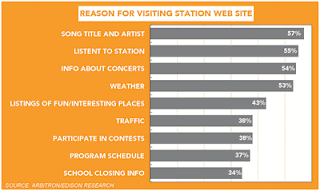
Visiting station Web sites – shown in the figure at right are the reasons that people give for visiting a station’s Web site, with “song title and artist” being the most popular. Consumers say radio station Web sites are improved compared to a year ago but TV and print sites are leading the local battle. Monthly visitation by persons 12 and older to radio station Web sites (16 percent of those responding) lags visitation to local TV (27 percent) and local newspaper (also 27 percent) sites. Nearly half of people age 12 and older give credit to radio for improvements in their W
eb sites. Forty-eight percent say that radio station Web sites have gotten more interesting compared to 17 percent believing them to be worse or less interesting.
Greatest total impact – the survey asked respondents to indicate which platforms and devices have a “big impact” on their lives, and the resulting data was combined with the percent who use or own those devices and platforms to create a measure of the “greatest total impact” shown in the graph at right.
Interactive research and technology firm Vision Critical (New York, NY, www.visioncritical.com) conducted a survey and released the results (also in April 2010) in a report entitled “Radio Futures 2010.” Vision Critical surveyed more than 3,000 adults in the U.S., U.K. and Canada and found that while those in Canada and the U.K. are using applications on their smartphone or iPod Touch to listen to AM/FM radio, U.S. users are more likely to use their apps to listen to Web-only radio and music streaming services. Among adults in the U.S. who have listened to online-only radio in the past month (see graph below), Pandora leads the pack as the favored online music service (42 percent having listened in the past year), followed by Rhapsody (6 percent), last.fm (5 percent) and Yahoo! (5 percent).
At the time of the survey, nearly one-third (31 percent) of U.S. smartphone and iPod Touch users said they’ve listened to Internet radio or a music streaming service on their device in the past week. In contrast, just 19 percent reported listening to an AM or FM station on the same platform.
According to the Vision Critical study, listeners to Web-based services expressed a clear preference for personalized versus “one-way” broadcast streams. Online consumers who turn to Web-only music or streaming service in the past month showed a particularly active interest in services that offer some degree of control. Fifty-three percent of respondents said that they were “very interested” in streaming where it is possible to play a song on demand, while only 24 percent were very interested in radio that plays music mixes designed by “music experts.”

12 novembre 2009

Radio online USA, fanno discutere i rilevamenti di Ando

Nei giorni scorsi negli Stati Uniti Ando Media, la Arbitron della radio online, la società cioè che misura il successo delle emittenti su Web (incluse quelle che appartengono alla Katz Online Network, la più estesa del paese), ha convocato un "webinar", una conferenza stampa su Internet, per commentare la pubblicazione dei dati di ascolto da maggio a settembre. Ci sono state parecchie discussioni nel settore perché questi rilevamenti introducono, come era prevedibile, nuove metriche basate (come dice il commento di Taylor-on-Radio) sul censimento piuttosto che sul campione di ascoltatori. Non c'è niente da fare, conclude Taylor, la radio online è un'altra cosa e sta velocemente maturando. Lo dice chiaramente il consulente scrivendo che la radio online "avverte la sua adolescenza e vuole rompere i legami" con la radio tradizionale. Per questo dovremo abituarci - gli inserzionisti pubblicitari in testa - a metriche come le "session start", il numero di stream di almeno un minuto attivati in un dato arco di tempo, o le Average Active Sessions nell'intervallo di tempo. Tutti dati che possono essere misurati con precisione, alla fonte, e non vengono proiettati statisticamente sulla base del presunto comportamento degli ascoltatori. I numeri di Ando Media sono, di fatto, molto più oggettivi, e non deve certo stupire se le reazioni negative davanti alle sue classifiche vengono proprio da aziende di "ad placement" come TargetSpot. E' il bello della pubblicità su Internet, bellezza. Per leggere il report di Ando Media cliccate qui. Interessante osservare che i rilevamenti includono anche i canali di Pandora.

Ando Media – apologies, but no mea culpas.

Patrick Reynolds of the online measurement service tells yesterday’s hastily-called webinar “if we’ve created confusion” by adding new metrics such as “Session Starts” - “I apologize. That wasn’t our intention.” But he’s not saying they screwed up with the new-look online ratings that were issued last Friday. He’s dealing with some upset “publishers” of content and clients, including TargetSpot. That large ad-placement company came on board with Ando in April. But it asked not to be included in last Friday’s release of data from May through September. (At least that’s the clear inference from Reynolds’ answer during the Q&A – “The customer has to give permission” for their data to be included.) I told you in yesterday’s T-R-I that Triton-owned Ando Media was moving swiftly to address the gripes, and Reynolds says overall, the feedback’s been more positive than negative. Give him credit for going solo and live during a 45-minute webinar during which he addressed some pretty tough questions. He even gave out his cell phone number, and says Ando will begin holding regular conference calls and will keep talking with customers, whether at a “brown-bag lunch” with an agency or on a webinar. So what’s all the fuss about?
Senior VP Patrick Reynolds says the traditional-looking Average Quarter Hour (AQH) and cume figures “still exist” - but “we’re adding some new metrics that we think are more meaningful in a digital world.” Such as “Session Starts” (defined as “the number of streams of one minute or more that are started in a time period”). “Average Active Sessions.” And “ATSL”, or Average Time Spent Listening. Those are the metrics that Ando Media used for its controversial May-September numbers (see them here.) And they’re the categories it intends to continue highlighting with the upcoming October Webcast Metrics and beyond, because – Online radio is feeling its adolescence and starting to break away from the terrestrial radio way of thinking about its consumption and its measurement. That’s really the underlying story with Ando – there’s a new paradigm for the growing universe of online radio. (Ando’s Patrick Reynolds says that some 8,000 streams are part of his world.) Traditional AM/FM radio and this newer digital offshoot are different in a lot of ways, and that’s what Reynolds keeps coming back to. Ando’s measuring the listening using what researchers call a “census-based” methodology as opposed to “panel-based.” Ando is getting actual usage data from its customers. There are bugs to be worked out (somebody muting a stream at work or leaving the computer unattended). But Reynolds says the census-based approach provides “objective measurement, no sampling errors, no audience bias, real time measurement.” They don’t yet know a lot about individual listeners, compared to a diary keeper. They don’t have a complete handle on “uniques”, since more than one person might be using the same computer or mobile device. But that’s coming. So is ethnic-identified measurement. And station-specific ratings (“very, very soon”). So Ando’s forging ahead, despite the pushback, because they think it’s where online radio needs to go.


20 aprile 2009

RadioTime e Ando misurano l'audience online

RadioTime e Ando Media stanno collaborando per offrire agli inserzionisti e ai broadcaster online gli strumenti per la gestione delle loro campagna attraverso una precisa misurazione dell'ascolto della radio online.
RadioTime è un catalogo di emittenti che trasmettono via Internet e la sua tecnologia si sta diffondendo in una quantità di applicativi per pc e dispositivi palmari nonché nella nuova generazione di apparecchi radiofonici con interfaccia di rete (preferibilmente Wi-Fi). Troviamo il database di RadioTime a bordo di software come WunderRadio e RadioShift Touch per iPhone, nel Radio Companion per Blackberry, nelle versioni Windows di RadioTime, ma anche in apparecchi come Sonos Music System, Logitech Squeezebox e persino in una linea di accessori software che rendono le stazioni catalogate da RadioTime accessibili anche ai non vedenti attraverso la navigazione vocale (il software si chiama SpeakOn ed è sviluppato da A-Technic). Andate a visitare la pagina dedicata a tutte queste articolazioni della piattaforma RadioTime per accedere ai siti Web dei partner.
L'interfaccia di questo catalogo è intelligente. Si possono effettuare le ricerche per località, negli Stati Uniti e nel mondo. Per ciascuna località viene visualizzata la lista di emittenti ricevibili in FM. Se effettuate una di queste ricerche per l'Italia ottente un risultato un po' confuso, perché RadioTime tradisce le sue origini americane. Per l'Italia vengono elencate una decina di città, se scelgo Roma trovo che il flusso Real Audio di RAI Radio 3 è riportato nella pagina romana come attivo sui 99,9 in FM dall'Aquila... Insomma, siamo lontani dalla perfezione, c'è parecchia strada da fare, ma intanto posso accedere direttamente da qui al flusso di Radio 3 e lo posso ascoltare se ho Real Audio installato, semplicemente aprendo la finestra del tuner di RadioTime.


Ando Media and RadioTime Facilitate the Navigation and Monetization for Internet Audio

RadioTime, Inc., a developer of technology for finding and listening to radio online, and Ando Media, a provider of solutions that empower radio stations to monetize their audiences, today announced they have partnered to provide radio broadcasters with a robust navigation utility and audience measurement statistics for the RadioTime community. This information will further enable broadcasters and listeners to engage one another online.
“The Internet is the new radio tuner, and that creates new revenue-generating opportunities for broadcasters and their advertising partners,” says Dan Halyburton, President, RadioTime. “RadioTime has made broadcasters’ programs available to listeners on their PCs, laptops, iPhones, Windows Mobile devices and an ever-growing variety of connected devices. Partnering with Ando Media will provide our broadcast partners with additional information about their online audiences' listening habits so they can create effective and strategic advertising campaigns.”
“We are excited to be working with RadioTime. As the Internet audio space explodes and IP based delivery becomes mass market there is and will be a need to organize and present stations efficiently to the listener. Our goal in this partnership is to provide the RadioTime affiliates with statistics on their audience and inventory to contribute to their bottom line,” says Paul Krasinski, EVP of Ando Media.

About Ando Media

Ando Media is the leading provider of real-time audience measurement and ads management solutions for the internet audio market. Founded in 2004, Ando Media is committed to enabling its clients to monetize their digital assets: audio, online, video and mobile.

About RadioTime

RadioTime is the leading radio tuner that powers Internet services and devices by connecting them to radio broadcast DJs, talk personalities, and sports programming. Listeners easily access free, live, local, and global radio programming through RadioTime service. Its service enhances other products and services by powering them with thousands of radio channels and programming. RadioTime, founded in 2002, is based in Dallas, Texas. More information is available at www.radiotime.com.

19 aprile 2009

Arbitron Edison: lo stato della radio online negli USA

Quasi il trenta percento degli americani ascolterebbe con regolarità la radio attraverso Internet. I risultati dell'ultimo studio di Arbitron e Edison Research (Infinitedial) sulla radiofonia e i media digitali negli Stati Uniti tratteggiano il quadro di un mezzo ancora vitale, ma ormai intrecciato con i destini del Web e della larga banda fissa e mobile. Sapranno i sistemi di modulazione/trasmissione digitale scavarsi uno spazio in questo scenario? Forse, ma appare ogni giorno che passa uno spazio più problematico. I contenuti della radio vengono sono veicolati da infrastrutture diffusive di tipo convenzionale e in misura crescente dalle varie articolazioni delle reti Ip. Le modulazioni digitali che conosciamo sono un terza via che cerca di prendere in prestito il meglio dei due modelli: la capacità di coprire con una sola antenna interi bacini di ascolto del broadcast e quella di intrecciare in un unico flusso informazioni di tipo testuale e multimediale della modulazione numerica (cosa che con le modulazioni analogiche è possibile solo in parte). Intendiamoci, non è una idea sbagliata. Solo che finora non hanno funzionato i modelli implementativi e la radio digitale non ha convinto come tracciato evolutivo di una radiofonia che avrà i suoi difetti ma che evidentemente continua a funzionare. E che sta trovando da sola il modo di cambiare, sfruttando le naturali sinergie con un altro mezzo.
La versione PDF della presentazione dello studio Arbitron Edison si può scaricare qui. Sul sito Arbitron trovate anche lo storico degli studi precedenti dal 2006 a oggi.

Study: Online Radio Gaining in Popularity
April 16, 2009

Paul Heine, Radio and Records

There is good news in the radio industry: online radio is gaining in popularity. The number of Americans that tune in weekly to online radio grew to 42 million, up from 33 million in 2008. Stuck in the 11 percent to 13 percent range for the past three years, weekly online listening now reaches 17 percent of the population, according to Arbitron and Edison Research, which released their 17th annual Infinity Dial study Thursday (April 16).
The number of monthly online listeners is 69 million or 27 percent of the population. And nearly half of the population, or 49 percent, an astounding 125 million, have ever listened to online radio.
The Arbitron/Edison survey, conducted this year from January 16 to February 15 with 1,858 participants, also showed the demographics of online radio listeners don’t skew as young as they once did, more closely resembling the audience composition of traditional radio. Twenty percent of adults 25-54 said they listened to Web radio in the last week, up from 15 percent a year earlier.
"The sharp growth in weekly usage of online radio in this year's study provides compelling evidence that radio's digital platforms may be reaching critical mass," said Bill Rose, senior vp of marketing for Arbitron. "The growth of online radio is reinforced with what we are seeing in the portable people meter. We are beginning to see encoded streams of AM/FM broadcasts with significant audience in local markets."
Still, iPod usage is cutting into the time people spend with radio. While the penetration of iPod or MP3 player ownership plateaued among 12- to 17-year-olds at 71 percent, it rose sharply among older demos: from 51 percent to 64 percent among the 18-24 demo; from 48 percent to 55 percent among 25-34 demo; 46 percent to 52 percent among 35-44; 31 percent to 34 percent among 45-54; and 15 percent to 24 percent among 55-64. Across all demos, more than four in 10 own an iPod or MP3 player, up from 25 percent in 2005.
While broadcasters can take some comfort in the fact that only 14 percent of listeners report less radio listening due to time spent with their iPod (up from 10 percent last year), that number masks alarming youth audience erosion. A full 32 percent among the 12-17 and 18-24 age groups say iPod usage has cut into their radio listening time, up from 22 percent and 17 percent, respectively, in 2008.
The new figures parallel incremental increases in online audiences reported by radio companies, which are betting that online radio develops into a lucrative revenue stream. Clear Channel, which has been developing its online presence for more than four years, has seen streaming comprise between 10 percent and 15 percent of station audiences.
Advertising dollars have followed. According to a number of sources, online radio revenue accounts for between 5 percent and 8 percent of a group's total revenue. For example, estimates put Clear Channel’s online advertising, including in-stream spots, account for close to 5 percent of the company’s total $3.3 billion in radio revenue.
"Web radio is one of the bright spots; dollars are migrating there," said Brad Adgate, senior vp and director of corporate research for Horizon Media. "The future for Internet radio is perhaps brighter than over-the-air radio."
A cross-current of factors is driving the spike in Web radio listening. For one, the availability of high-quality, professionally produced online video has consumers spending more time in front of their computer screens. Internet video consumption solidly increased last year, from 18 percent of survey respondents saying they watch it on a weekly basis in January 2008 to 27 percent, or roughly 69 million, this year.