Visualizzazione post con etichetta Filippine. Mostra tutti i post

05 dicembre 2013

La voce amica di First Response Radio nelle Filippine colpite dal tifone

Dire che la radio può essere molto utile nelle situazioni di emergenza causate da eventi che impattano le infrastrutture di base è banale. Ma proprio l'impatto infrastrutturale rende complessi gli interventi e ammirevoli le iniziative come questa di First Response Radio, una organizzazione in seno alla Far Eastern Brodcasting Company, una "charity" internazionale particolarmente attiva nel sud-est asiatico. Quando il tifone Haiyan ha colpito duramente le Filippine, una squadra di First Response di Manila ha letteralmente preso le due valigette che servono per trasportare tutto l'equipaggiamento necessario per impiantare una stazione FM di media potenza ed è partita per Tacloban City. Dal 13 novembre in quella località opera una stazione radio di emergenza che offre un costante supporto informativo alla popolazione in un raggio di oltre 60 chilometri. Il trasmettitore è di 600 watt utilizza i 98,7 MHz e l'antenna è stata montata sul tetto del municipio.
First Response Radio fa parte di un circuito mondiale chiamato CDAC Network, attivo a livello globale. Ogni volta che un disastro naturale o un evento distruttivo compromette la capacità di comunicazione a livello locale, l'organismo può mandare sul posto sistemi di trasmissione autonomi e si occupa persino della distribuzione di piccoli apparecchi radio ad alimentazione solare o a manovella tra la popolazione. A Tacloban non è rimasta in piedi nessuna emittente radiotelevisiva, l'elettricità ha smesso di arrivare e la voce di First Response è l'unica fonte che gli abitanti possono seguire per ritrovare i dispersi e interagire con le autorità e le associazioni di volontariato che stanno prestando i soccorsi e avviando la ricostruzione. Recentemente Voice of America ha realizzato un reportage, che potete visualizzare qui in basso insieme a un breve filmato istituzionale.


27 gennaio 2009

Filippine, giornalista coinvolto in un ambiguo delitto

E' avvenuto sullo sfondo del quarantennale scontro tra autonomisti islamici e autorità ufficiali di Mindanao l'ennesimo omicidio di una personalità radiofonica delle Filippine. Cinque vittime nel 2008, un totale di 59 dal 2001 e anche quest'anno sembra cominciare nel segno di una deprecabile tradizione.
Così le fonti governative e la polizia, come si legge nelle corrispondenze della Reuters e del quotidiano locale The Inquirer, si affrettano a sottolineare che la vittima, Badrodin Abas, titolare di un programma della stazione DXCM di Mindanao (nell'area dell'unica regione filippina con governo autonomo), non era il vero bersaglio. La sua unica colpa era di essere molto simile al fratello, sospettato di essere coinvolto in un triangolo amoroso e a quanto sembra più volte minacciato di morte. Ma la teoria degli inquirenti potrebbe non essere quella giusta: Badrodin apparteneva al gruppo islamico e nei suoi programmi pur occupandosi di religione non risparmiava critiche agli oppositori del piano di accordo territoriale con gli indipendentisti musulmani.

Mistaken identity costs radioman’s life

By Edwin Fernandez
Mindanao Bureau
01/22/2009

COTABATO CITY -- A blocktime radio broadcaster here was shot dead by unidentified gunmen around around 9 p.m. (not 7:40 p.m. as reported) Wednesday in what police said Thursday could have been a case of “mistaken identity.”
Senior Superintendent Willie Dangane, city police chief, said Badrodin Abas, 38, of radio dxCM and of the Bangsamoro Consortium of Civil Society, was driving his multi-cab when the gunmen, who were riding on tandem on a motorbike, blocked his way and immediately fired on him.
The victim died instantly from bullet wounds to the head, Dangane said.
In separate interviews with the Inquirer and INQUIRER.net, Dangane said the killing of Abas was "not an attack on a media person; it was clearly a case of mistaken identity."
Dangane said they learned that the real target of the gunmen was the victim's brother, whom he did not identify.
"He was mistaken for his brother because they really looked similar," Dangane said.
Dangane said a manhunt was already launched against the gunmen.
He said a closed-circuit TV camera near the area where Abas was gunned down captured the brand and type of motorcycle the gunmen used.
The victim's younger brother was supposed to drive the multi-cab on Wednesday night but Abas reportedly insisted on driving it after his radio program.
"It was not work related," Dangane said.
He said police pursued another angle when they learned that Abas' program was more on the propagation of Islam.
"As a radio blocktimer, Abas was objective in his program and dealt more about religion and not on the prevailing armed conflict in the region," Dangane said.
Asked what could have been the motive of the gunmen, Dangane said they found out that Abas' younger brother had been embroiled in a love triangle.
With a report from Abigail Kwok, INQUIRER.net

***

Gunmen kill radio commentator in southern Philippines

Thu Jan 22, 2009

MANILA (Reuters) - Two gunmen shot dead a local radio commentator in the southern Philippines, police said on Thursday, the first journalist killed in the country this year.
Badrodin Abbas was attacked by two passengers on Wednesday night when he was driving a mini-bus usually operated by his brother, police said.
The Philippines is one of the most dangerous places in the world for journalists -- five were murdered last year while 59 have been killed since 2001, based on records from the National Union of Journalists in the Philippines.
"We're still trying to find out if the killing was related to his work as a journalist," Willie Dangane, police chief in Cotabato City on the southern island of Mindanao, told reporters.
"We have heard rumours that he could have been mistaken for his brother who was receiving constant death threats," he added.
A Muslim, Abbas was using his radio programme to promote Islam and attack opponents of a proposed territory deal between Manila and Muslim rebels fighting for self-determination for 40 years.
A government taskforce investigating journalist killings condemned the murder of the radio commentator.
"It is lamentable that the year has hardly begun, yet another journalist has been killed," said Ricardo Blancaflor, undersecretary at the justice department and head of taskforce 211, adding he had sent a forensic team to investigate.
Under fire from local and international human rights groups, the government has vowed to track down killers of reporters but there have been few convictions.

09 agosto 2008

Filippine, ennesima uccisione di un giornalista.

Secondo Reporters Sans Frontieres, le Filippine sono il posto più pericoloso del mondo per i giornalisti dopo l'Iraq. Che è come dire: le Filippine sono il posto "normale" più pericoloso del mondo per i giornalisti. L'ultima vittima in ordine cronologico si chiamava Martin Roxas, commentatore radiofonico per il Radio Mindanao Network. Lo hanno freddato giovedì scorso mentre sulla sua motocicletta se ne stava tornando a casa, da una moglie e due figli di tre e un anno. Altro che Iraq. In quel vaso di Pandora allegramente frantumato dalla peggiore politica estera in 230 anni di governi americani, i giornalisti ci vanno dentro i bindlati, con elmetto e giubetto antiproiettile. Le Filippine sono una nazione indipendente, dove dovrebbero esistere dirittti civili, uno non si aspetta di essere fatto fuori perché un politico locale da quattro soldi, democraticamente messo in discussione nel corso di un tuo programma, si incazza e paga dei killer per mettere a tacere una voce scomoda.
E invece Martin è il quarto giornalista ammazzato quest'anno. Nel 2006 erano stati dodici, "solo" tre nel 2007. Non è un bel mondo quello che con violenza si libera frettolosamente di un mestiere che tutti noi dovremmo considerare prezioso e fondamentale: raccontare la realtà che ci circonda.

Radio broadcaster shot and killed in Capiz

Agence France-Presse

A radio broadcaster was shot and killed Thursday in Capiz, just three days after his colleague was critically wounded in a similar attack, their employer said.
Martin Roxas, 32, program director of Radio Mindanao Network (RMN), was shot dead just minutes after leaving the station at around noon in central Roxas city.
"He was aboard a motorcycle, and was just 900 meters (3,000 feet) away from the station when a gunman shot him in the back of the neck," RMN radio station manager Ely Abarra told AFP.
"He was rushed to a nearby hospital, but was declared dead on arrival," Abarra said.
Roxas, who leaves behind a wife and two children aged three and one, had been a radio commentator for over a decade. His program tackles local politics, and police said it was possible he could have been attacked because of his work.
Abarra said there was an apparent attempt on Roxas recently, when he was kicked from his motorcycle. Roxas dismissed the incident, but had been taking precautions.
"This week, his topics touched on an ongoing political squabble involving two politicians," Abarra said without elaborating.
Meanwhile, colleague Dennis Cuesta remains fighting for his life in hospital after he was shot in General Santos city Monday.
The attacks come more than a month after gunmen shot and killed Bert Sison, a reporter for a community newspaper in Quezon province. Sison's daughter, who is also a journalist, was wounded in the attack.
Roxas is the fourth journalist to be killed in the Philippines this year.
The New York-based Committee to Protect Journalists and French group Reporters Without Borders have branded the Philippines the second most dangerous place for working journalists outside Iraq.
Three journalists were killed in the Philippines last year, while 12 were killed in 2006.

17 aprile 2008

Sex and rock'n'roll nell'etere FM di Manila

Cambiano i gusti del pubblico anche nell'area metropolitana di Manila, Filippine. E la banda FM si adegua con nuovi format, soprattutto musicali. Lo racconta questo divertente articolo dell'Inquirer, che cita tra i programmi di maggior successo Talk to Papa (dillo a papà), un phone in di consigli ai giovani trasmesso da Barangay LS (ex Campus Radio), i cui argomenti di natura sessuale hanno già spinto l'episcopato cattolico della capitale a protestare.

Race for top FM radio station intensifies

By Pocholo Concepcion
Philippine Daily Inquirer
First Posted 04/15/2008

MANILA, Philippines—Fierce competition and an obsession with ratings have driven Metro Manila’s FM radio stations to revamp their programming.
For the past several years, a number of these stations have been changing their names - “branding” in marketing parlance - to go with the format shift.
The former jazz station City Lite is now Jam 88.3, which plays acoustic pop-rock. DMZ (Dance Music Zone) has mutated into Wave 89.1, which champions R&B.
KY 91.5, which played classic rock in the late ’80s, has become Energy, a pop and oldies station. The easy-listening, no-DJ, Crossover-sound-alike that was Joey 92.3 first became xFM, which experimented with club music, then settled down with smooth jazz. KC 93.9 is now i-FM but still plays the same mainstream pop. K-Lite 103.5, which used to play alternative rock, switched to easy listening and called itself Heart, and then diverted to contemporary pop as Max FM. And what used to be the eclectic pop sound of Kool 106 has been altered into a jazz-flavored adult contemporary mix now known as Dream FM.
(continua)

27 febbraio 2008

Da Radio Veritas alla stella di sceriffo, Efren-2

Ecco la seconda parte, dall'Inquirer delle Filippine, della biografia di Efren Dato, pacifico rivoluzionario di Radio Veritas. Carlo Osi racconta che Efren ha gettato la tonaca, ha messo su famiglia adottando una figlia ed è diventato cittadino americano candidandosi poi all'ufficio di sceriffo di contea.
Once there was a Radio Veritas Priest Part II

By Carlo Osi
Posted date: February 27, 2008

PHILADELPHIA, USA – From his brief two years at the University of Philippines, his near expulsion from the seminary, his efforts to empower the youth as a parish priest, his rise as a cleric-broadcaster of the eminent radio station, Fr. Efren Dato had been a consistent activist and reformer.
Still a priest after the martyrdom of Ninoy Aquino he was ready to give up his pastoral priesthood and Radio Veritas duties for the communist revolution in the ‘80s. EDSA I made him abandon all thoughts of violent revolution.
In a Philippine Panorama interview in March 9, 1986, Fr. Dato was quoted as saying in a TV appeal that historic February: “The real glory of the people’s revolution lay in the magnanimity of the victors.” Great words from a priest at the forefront of a peaceful revolt, but they would soon be challenged by insistent allegations of corruption in the new government.
He felt betrayed that although Cory Aquino may not have been directly involved in anomalies, the people surrounding her certainly were. It seemed a mere duplication of the Marcos dictatorship, if with more subtlety and less ostentatious greed
Something was obviously wrong in the new government, but there was something equally wrong with the people themselves. Now that previously oppressed members of the opposition were the new oppressors, the subject of oppression had not changed: the Filipino people allowing themselves to be let down. Dato recalls the stinging pain he felt that “the people and the leaders became selfish again. Only if we can have individuals who can graciously sacrifice for the service of the people can real change happen, including change in the Church.”
Though frustrated, his life was not static. Fr. Dato was NBI chaplain and a frequent lecturer at the National Defense College and other government agencies. He was also a parish priest in Pulilan, Bulacan, where he offered free baptism and wedding services, instituted public accounting of funds and empowered lay people to get involved in parish administration.
This priest began turning another corner in November 1991. Resigning from the Pulilan parish, he left for Manila to continue with his full time media ministry and political activities. Eventually he found himself actively campaigning for then candidate Fidel Ramos. When Ramos won, he appointed Fr. Dato Presidential Chaplain and Consultant on Interfaith Issues.
Despite these multifarious activities and appointments, however, a void was growing in his life. He wasn’t sure whether he was spoiling for a fresh challenge or really longing to have a family of his own in mid-life crisis. He also felt that despite a newly elected and credible president, the government and the people were being sucked into the same corrupt black hole that the Marcos years had been.
Fr. Dato suddenly left for the United States in December 1992 the way he abruptly left the UP to enter the seminary in 1969. He was hoping to find a resolution in distant America.

Longing for a Family of his Own

He was assigned Associate Pastor at the St. Thomas More parish in New York. Later, he would also be assigned to St. Raymond Parish in East Rockaway and St. John Nepomucene in Bohemia, both in New York.
A country with an already established democratic system did not have much use for his radicalism so Fr. Dato immersed himself in organizing the parish and outlying communities into a healthy congregation.
Older and calmer now, he also pursued further studies –
a Master of Science in Training & Human Resource Management at the University of Leicester in England, 12 credits in Pastoral Planning & Research in New York’s Fordham University, and the Leadership Education Program in Harvard University’s Kennedy School of Government.
His impact on the community in his first few years in the United States was summed up by a U.S. Assistant Deputy Commissioner who described Fr. Efren Dato as “a warm, charismatic and respected clergyman, a scholar and human being of rare and special merit.”
But Fr. Efren Dato still wanted a family of his own when friends introduced him to a beautiful Filipina, a recent immigrant working in Information Technology. When they were wed in a civil ceremony in June 1996, many of his former New York parishioners felt betrayed and angered. Thinking he had only fallen victim to the temptations of sex and other material concerns, family and friends shared his parishioners’ antipathy against his decision.
The former priest reflected, “Celibacy is a hallmark institution of the Catholic Church. If you cannot adhere to it anymore, it’s time to get out of the Church and live as a layman. That’s what I did, that’s what I honestly felt. Staying a priest while engaging in extra-marital and illicit sex would have been a grave sin no priest could or may ever be forgiven for.
“I left the priesthood because I respected the gift of celibacy, a vow I could no longer uphold. I respected the Church so much that if I cannot commit anymore to even just one of the priestly vows then I have to terminate my role as a priest. It wasn’t because of a woman or the irresponsible idea that women are temptresses. It’s nothing like that. It was about making a rational choice. Do I want to have a family of my own or not? I chose to have a family.”
Efren Dato’s decision can be contrasted with that of another former priest, the Fil-American Rodney Rodis, recently sentenced by a U.S. District Judge to 63 months in prison for stealing more than $600,000 in donations from the St. Jude Church and Immaculate Conception Catholic Church in Louisa County, Richmond, Virginia.
He had used the stolen money in part to support his secret family – a wife and three children. He also used some of the money to wire to relatives overseas who used it to buy real estate.
“Why steal? Why raise a family without telling the Church? Why disobey the vow of celibacy without ending his vocation as a priest? I feel vindicated with my decision in 1996. Now people can say I made the right choice. Better a married layman than a priest with a secret family,” says Efren Dato, ex-priest.

Candidacy for Sheriff

He had entered the priesthood to fulfill his mother’s dying wish in 1968. But his first love was Political Science and he had dreamt of going on to the prestigious UP College of Law and then becoming an NBI Agent.
The call of the priesthood seemed to have snuffed out those dreams. After marriage in 1996, however, Efren Dato felt the urge to return to his boyhood dreams. Too old to re-enroll in Political Science or enter law school, he set his heart on becoming an elected U.S. official, specifically a County Sheriff, in 2004.
The popular image of a Sheriff in old Western movies is a gun-toting, booted, silver badge-flashing officer in a cowboy hat. In modern-day New Jersey, the Sheriff is not an actual police officer but a formal authority in charge of protecting the courts, implementing warrants of arrest, managing jails and, if need be, patrolling the streets and arresting criminals.
The Sheriff position was consistent with Efren Dato’s youthful NBI Agent dream, a “dating paring gustong magpulis-pulisan” (a former priest wanting to play cop).
How he managed to become the Democratic Party candidate for Sheriff in 2004 after becoming a U.S. citizen only in 2001 was a feat in itself. Campaigning on the slogan “New Leadership for New Challenges,” he emphasized that much had changed after 9/11 and society must respond appropriately to these changes.
He cited his past leadership roles and counter-terrorism experience. He banked on his experience as NBI Chaplain, education in Harvard and England, training in Community Policing at the Somerset Police Academy and District Chaplaincy of the Franklin Township Fire District 3.
Nor did Efren Dato rely merely on the Asian vote; many Caucasians and African-Americans voted for him as well. At certain points in the campaign, he also told voters of his former vocation as a Catholic priest, his being a man of God and a man of the people.
At that stage of his uniquely evolving life, Dato’s love for educating and organizing people had not waned. It may have in fact gotten stronger with transplanting to a contrasting environment.
He lost the election but not without a good fight. Contending with a Caucasian and an Italian-American ex-policeman candidate, a Filipino ex-priest, who was also the first minority to contest the position, came in an astounding second to the Italian-American winner, who was both the incumbent and a policeman for 30 years.
Despite electoral loss, Efren Dato had established a strong Filipino presence in New Jersey township society. Belonging to a minority was never a disadvantage; he brandished it like a sword. He also remained a politician in his New Jersey township of Franklin. Now he’s Third Vice-Chairman of its Democratic Party and an ardent supporter of presidential hopeful Barack Obama.

Leadership, Family and Friends

Efren Dato has been Deputy Director of the Office Economic Development in his township and presently manages his own consultancy while serving as Executive Director of Hamilton Street Business & Community Corporation. He is involved in economic development, program planning, budget development, public relations, training and marketing. He also helped establish the Minority Business Alliance and is a Commissioner of the Franklin Township Sewerage Authority.
He says he has no regrets whatsoever in his life. It does not matter to him that he needed to uproot himself from the Philippines to get a balance on things. “I am very content with how my life has evolved … so far,” he says with a chuckle. “I’m proud of my family, especially my daughter who is a blessing from God as she was at one point clinically dead for 20 minutes, spent a month at ICU, and still needs constant medication.
“I’m happy as well with my current accomplishments in the United States, particularly in Somerset County. I’ve done a lot of work, made the Filipino-American and Asian communities proud, and have even run for an elective position which I almost won – well, nearly.”
Four years ago, he was given an Achievement Award by the group Pakistanis for America for assisting them in their concerns. He was also the recipient of a U.S. Census 2000 Award, elected President of the UP Alumni Association of New Jersey, and has been appointed or elected in many other organizations.
Looking back at EDSA I, he says, “Certainly it would have been better if the role I played as an instrument of God himself was accorded better attention, not because I wanted more publicity or awards for myself but because I was doing it in the spirit of humanity and the common good. In the EDSA book of Fr. Reuter, the emphasis was on a lot of personalities – the important ones and also the people who just suddenly showed up at the end. There was a mere one-liner on me.”
He was cited by the Armed Forces of the Philippines with an Outstanding Civilian Award and given a Special Award for Press Freedom by the Rotary Club of Manila in 1986. But he was never considered for an award by the Edsa People Power Commission.
Efren Dato is relatively unknown as a crucial participant in EDSA I today, but old friends, among them his fellow progressive priests, remember. Former President Fidel Ramos, Supreme Court Justice Leonardo Quisumbing, Manila Mayor Alfredo Lim, ex-DOJ Secretary Silvestre Bello and Representative Neneng Nicolas were also principal sponsors of his church wedding in the Philippines December 2007. That wedding was canonically facilitated with the timely arrival of Pope Benedict XVI’s Dispensation that formally allowed a former priest to marry in church. He has long dropped the title “Father” but you can also still see a parish priest in Efren Dato’s face and hear the Radio Veritas broadcaster in his voice.

Quel prete rivoluzionario di Manila

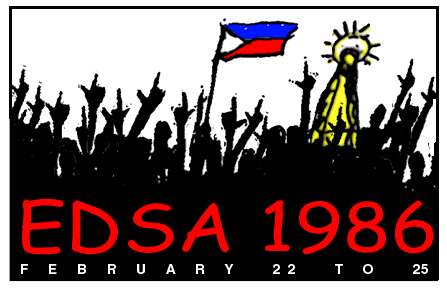
C'è il giornalismo cattolico di Avvenire, il quotidiano vescovile che ritiene Umberto Veronesi - uno che in materia di lotta alla sofferenza vera, concreta, quotidiana, non astratta o magari embrionale, forse può dirci molto più di certi vescovi - inadatto a rappresentare gli elettori italiani in Parlamento. E c'è il giornalismo cattolico di Efren Dato, notevole figura di prete militante (non mercenario) che dai microfoni dell'emittente cattolica filippina Radio Veritas, vent'anni fa, fu una delle voci più seguite della rivoluzione anti-Marcos. Una rivoluzione pacifica, che ebbe il suo culmine nelle manifestazioni lungo la EDSA, ovvero la Epifanio de Los Santos Avenue, la lunga tangenziale che abbraccia la megalopoli nota come Metro Manila. Ferdinand Marcos, che a quanto dicono gli storici fu secondo, per corruzione, al dittatore indonesiano Suharto, fu in pratica costretto alla fuga dalla rabbia espressa senza violenza dalla folla. Aveva accumulato una ricchezza personale immensa scaricando una montagna di debiti sui suoi connazionali. Il ricordo di sua moglie Imelda resterà per sempre scolpita nell'immaginario collettivo di mezzo mondo per gli armadi pieni di scarpe (almeno un migliaio di paia). Efren denunciava regolarmente le porcherie dei "cleptocrati" dalle sue trasmissioni e per il suo incredibile lavoro di rivoluzionario di stampo gandhiano ottenne un premio intitolato alla libertà di stampa riconosciutogli dalla Philippines Catholic Mass Media Award e dal Rotary International Club di Manila. Sembra di sognare, guardando ai giornalisti che oggi vengono premiati dalle istituzioni cattoliche...
Ma torniamo a Efren. La sua biografia è davvero sorprendente. Dopo la rivoluzione in patria Efren si spreta, emigra negli Stati Uniti, mette su famiglia e si fa eleggere pubblico funzionario nella contea del New Jersey dove risiede. Gli avvenimenti di allora e il suo ruolo a Radio Veritas e nelle altre emittenti radiotelevisive che guidarono, vent'anni fa, non ventimila, l'opinione pubblica filippina, viene revocato in questo lungo articolo apparso sul Global Nation Inquirer, testata online filippina, e firmato da Carlo Osi. E' solo la prima parte della storia, spero che la seconda venga pubblicata presto. Per una dettagliata cronologia degli avvenimenti, potete consultare il sito di Angela Stuart-Santiago e anche questo approfondimento sul ruolo della radio nelle Filippine, firmato da Ramon Tuazon.
[Il mio post è stato linkato sul sito della società di consulenza di Efren Dato! Thanks, Efren, for having linked my post on your company's Web site, EDGlobal.biz. Reading about your own personal history was great.]
Once there was a Radio Veritas Priest

By Carlo Osi INQUIRER.net Posted date: February 26, 2008 (Part 1)

PHILADELPHIA, USA – Those fateful days in February 1986 now known as EDSA I are glibly remembered as a peaceful uprising that overthrew a cruel, overstaying and money-laundering dictator.
It also rekindles memorable images of Jaime Cardinal Sin, Cory Aquino, Johnny Enrile, Fidel Ramos, June Keithley and Gringo Honasan, all important, popular figures then and now. Media has contributed to cementing their historical image in books, articles, documentaries and clips.
But they were not the only ones who played a vital role in turning the tide against the dictator. Thousands of activists who had rallied, mobilized, organized and gave up their lives in the late sixties and seventies had paved the way. There were the millions who lined EDSA, Channel 4 in Quezon City and other urban areas nationwide, rallying until the Marcos government finally relinquished control.
And there were other, lesser known personalities who contributed tangibly to the fight for a better Philippines. Among them is Fr. Efren Dato whose biography is an amazing journey through all forms of activism – from his student days at the University of the Philippines, young priesthood and struggles as a progressive priest in a highly conservative Catholic jurisdiction, his unplanned venture into Radio Veritas, and eventual self-exile in the United States where he left the priesthood, started a family and ran for public office.
Fr. Dato, now just Efren Dato, is a remarkable source on the history of EDSA I and the years immediately following. His voice, analyses and appeal for peaceful resolution had lent a significant hand in the last days of struggle against the dictatorship - a man of the cloth in a dramatic role at a most critical time.

Brief Activism in UP

His political activism can be traced back to his days at the University of the Philippines in the late 60s. Unrest and dissension under Marcos’s draconian rule swept the country, particularly the state university. Fraternities instituted harsh physical initiations to weed out government infiltrator-applicants from legitimate students wishing to join their ranks. The First Quarter Storm – the mass demonstrations and street protests from January to March 1970 – was brewing.
A product of the public school system, Efren spent two years studying Political Science at the UP. He became a member of a then activist UP Student Catholic Action, a theatre society and, if his memory serves, even a left-leaning fraternity. A year into UP, Dato’s mother passed away unexpectedly In July 1968, with a dying wish for him to become a priest. At her funeral, he openly vowed to enter the seminary. A year later, he left the UP for San Carlos Seminary.

Entering Priesthood

Efren Dato’s transition from UP activism to the calmer setting of the seminary was inordinately difficult. He was still a reformer, even a revolutionary – aggressive, forthright, frank but with amazingly great people skills. He was, first and foremost, an organizer.
The seminary’s conservative doctrinal values were working on him but his activism seeped through. With a band of seminary classmates (later to be known as “The Eleven”), he led a protest against the decision of the late Cardinal Rufino Santos to dismiss five progressive Belgian priests from the Philippines. Intolerant of dissent, Cardinal Santos kicked the seminarian protesters out of the seminary due to “lack of vocation or desire to serve the priesthood.”
This meant that to continue with their priestly studies, adoptive Bishops had to accept The Eleven into his fold. They were scattered everywhere; Dato landed in Malolos, Bulacan. Surprisingly, despite the Cardinal’s admonition but perhaps due in part to the need of more priests in the countryside, he was ordained a priest on his third year of theological studies. In April 1974, only five years removed from UP, he became a priest at 23. He recalls those five years as a rather “short, unorthodox and simply irregular formation for most ordained priests.” He entered the seminary bearing a sickle; he left in a white cassock.
As a priest, he marshaled his efforts on community organizing rather than lead mass demonstrations against Martial Rule. Efren Dato was appointed Youth-Student Director of the Malolos Diocese, assisting the Student Catholic Action of the Philippines. Through these organizations, he was able to use his strong personality and enigmatic charisma to mobilize and empower the youth, as well as attend conferences and training abroad.
As a young priest and organizer in Malolos, his trainees including the future Bulacan governor Josie dela Cruz and the incumbent governor, her brother Jon-Jon Mendoza. While professing love for God in his homilies, Fr. Efren Dato was involved in political transformation in that period’s street protests and political rallies. He believed then that his “priestly ministry included politicizing the people as a constitutive part of evangelizing.”

Voice of Radio Veritas

In the 1980s, actress Nova Villa and the late veteran broadcaster Orly Punzalan were hosts of Radio Veritas, a Catholic broadcasting station transmitting from Fairview, Quezon City. While serving as guest entertainers in a San Carlos Seminary alumni function, they spotted the emcee with a credible radio voice. He turned out to be Fr. Efren Dato and they immediately invited him to be a guest on their radio program.
Guest broadcasting on Radio Veritas appealed to him immensely; it was his cup of tea. In 1981, he accepted the offer to be a full-fledged broadcaster, in time for the Papal Visit of the well-loved Pope John Paul II. Assigned to cover the historic visit, he was stationed close to the Pope as he himself was living at the papal nuncio’s residence.
Without formal broadcasting or media training, he was immediately rose in Radio Veritas ranks as an anchorman, producer and reporter. It even allowed him to take up broadcasting and management courses in Washington, DC, as a scholar in the mid 80s.
Fr. Efren Dato was on board when the EDSA uprising began in late February 1986. It was an ordeal that would forever change his life. He continued broadcasting during those tumultuous days without ever going home, shaving or getting well-deserved sleep.
One of the newsbreaks he broadcast then was the destruction of Radio Veritas’s Malolos transmitter by troops loyal to Marcos on February 23, 1986. Feeling that the Catholic radio station was not only highly critical of him but also moving in consonance with radical fronts bent on ousting him, the besieged President wanted to silence the station’s exhortative messages along with its influential broadcasters.
Angry to his radical core, Fr. Dato sought brief temporary relief from broadcasting lest he spew bitter words and livid outrage against the people shoring up the faltering Marcos regime. Several times he was cautioned by his bishop manager to either shut up or to at least tone down his dissidence. He was temporarily relieved by Fr. Larry Faraon, also a Radio Veritas priest but with a much calmer tone. Returning soon after, a less anxious Fr. Efren Dato resumed his radio voice.
Several times they received phone calls from Malacañang, instructing them to cease sensationalizing Defense Minister Enrile’s defection from the Marcos government. They did not heed these calls, a prime reason for the bombing of the Malolos transmitter.
With the destruction of the transmitter, Radio Veritas they needed another medium to speak the truth and encourage people to go to EDSA. With Lt. Col. Mariano Santiago leading a band of rebel soldiers, Fr. Efren Dato in a white cassock accompanied the raid on Channel 4, the “government-owned” TV station on Bohol Avenue in Quezon City. Gunfire from Marcos loyalist soldiers from inside the station greeted their arrival.
Fr. Dato and the soldiers had no a clear plan on what to do in case they succeeded in liberating Channel 4. All he knew was that “a medium to inform the people and broadcast the truth was of severe importance.” The rebels were able to seize control of the station with minor fatalities.
Fr. Efren Dato did not have the blessings of the Catholic hierarchy at Channel 4 but Channel 4 was an important continuation of Radio Veritas as the battle shifted from radio to TV broadcasting. Again the dictator Marcos threatened to bomb Channel 4 if they did not desist from broadcasting. Fr. Efren Dato, Maan Hontiveros, Orly Punzalan, a bandana-clad Lt. Col. Santiago and the rest of the contingent continued broadcasting.

Crystallizer of Cardinal Sin’s Advocacy

At that moment, helicopters were bombarding buildings along EDSA between Ortigas and Shaw Boulevards where rebel soldiers were strategically deployed. Meanwhile Fr. Dato and his Radio Veritas colleagues knew that bloodshed would ensue if they did not pacify the people. They needed to tell the truth about the actions of Marcos but could not incite people to take up arms and engage in bloodletting.
A key player in EDSA I was also the administrative superior of the Radio Veritas priests – the late Jaime Cardinal Sin. What Fr. Efren Dato and the rest of the broadcasters did was patch interviews with the Cardinal calling for peace and calm amid the storm of protest. They would then repeat his prerecorded voice over and over again. It was this sense of calm from the spiritual leader of the Catholic Church that stemmed the public’s seething rage.
As Cardinal Sin advocated a peaceful resolution of the crisis, Fr. Efren Dato crystallized his advocacy –quoting from the Bible and narrating scriptural teachings to shift a building momentum for violence to love, sacrifice, peace and brotherhood. Even as a radical priest, he knew that a provocative stance would not only counter the Cardinal’s message but also endanger life.
Some time in his UP years, he was tempted to go to the hills and continue the fight for change from there. As a priest in the turbulent 70s, he revisited that option but opted to empower the youth instead. From the radio and TV platform he next mounted, he could have brought back his revolutionary ghost and incited the people to depose Marcos by whatever means. Fr. Efren Dato did not do that. Though his voice quivered with emotion, he toed the Church’s and his own line.
Eventually he would find himself in America, where his radical temper would find new expression, but that’s for another day.
(To be continued)

The author is a Master of Laws candidate at the University of Pennsylvania Law School concurrently undergoing a cross-disciplinary program at the Wharton School. Send comments through http://eastofturtleisland.blogspot.com/.