14 dicembre 2010

La storia della radiofonia in formato PDF

David Gleason, un veterano della radiofonia nord e sud americana, con cinquant'anni di carriera come consulenta, manager e autore di programmi, sta mettendo insieme un incredibile archivio di pubblicazioni radiofoniche che parte dagli albori dell'industria e arriva più o meno ai giorni nostri, dalla rivista Radex (Radio Index) degli anni Venti in poi. Periodici, annuari, manuali, cataloghi di prodotti e apparati, tutto disponibile in formato PDF e gratuitamente! L'archivio si basa sulle raccolte personali di Gleason e sulle donazioni di altri collezionisti e cresce costantemente. La Radio's Online History Resource è già un sito-culto per appassionati e studiosi. Ricordo che esiste un risorsa analoga anche per le pubblicazioni storiche relative alla radio e all'elettronica in Italia. Si trova sul sito di Francesco Piva, ingegnere e biologo computazionale all'indirizzo http://www.introni.it/ (sezione Vecchie riviste)

USA: gli "streamers" ascoltano la radio solo via Internet


L'importanza di Internet come piattaforma di distribuzione di contenuti "radio-like" alternativa e complementare ai tradizionali canali broadcast è ormai un fatto compiuto e sarebbe un errore non considerare questo fattore nel cammino verso la digitalizzazione della radiofonia.
Uno studio effettuato negli Stati Uniti da Coleman Insight su un campione di persone che appartengono a quel 17% di quota di consumatori che ascoltano contenuti audio/radiofonici via Internet (gli "streamers"), rivela che queste stesse persone stanno assumendo un comportamento esclusivo: ascoltano *solo* via Internet. Una scoperta che deve fare paura ai broadcaster? Non del tutto, risponde Coleman Insight, perché l'analisi svolta dimostra che queste persone sono anche molto orientate a ritrovare su Internet i brand delle stazioni
AM/FM che prima ascoltavano via etere:

“On the surface these numbers should be of some concern to radio broadcasters,” said
Coleman Insights Vice President Sam Milkman, who authored the study. “However, our findings suggest that they are not the result of many streaming audio users disengaging from radio brands, but simply changing the distribution platform they use to consume radio content.”

Coleman pubblica sul proprio sito due report gratuiti intitolati Successful Audio Streaming Strategies e SASS, Additional Findings, uno rilasciato a fine settembre in occasione del RAIN Summit East organizzato dalla Radio and Internet Newsletter, l'altro con nuove informazioni analizzate a inizio dicembre. Tra i dati rilevati da osservare che la percentuale degli "streamers" che affermano di non seguire più la radio via etere è più elevata
nei maschi rispetto alle femmine, nei giovani rispetto ai vecchi (e questo non deve sorprendere) ma anche tra i cosiddetti consumatori di contenuti minoritari etnici, che evidentemente trovano più comodo utilizzare la rete per i loro ascolto. Un segnale positivo evidenziato dallo studio riguarda la percezione del valore del brand, che negli streamers tende ancora a premiare le stazioni radio e i pochi brand Internet di rilievo, come Pandora:


La conclusione è che gli spazi per chi offre questi contenuti nel "paesaggio mentale" dei nuovi ascoltatori via Internet è ancora tutto da conquistare. Mentre al contrario - aggiungo io - il paesaggio mentale della radio trasmessa via etere in tecnica digitale è ancora largamente desertico.

13 dicembre 2010

Sole, l'eruzione magnetica è globale

Il primo di agosto di quest'anno si è verificata una eruzione solare che con l'aiuto dei dati raccolti dalla missione Solar Dynamics Observatory e dalle sonde gemelle della missione STEREO, è stata classificata tra le più peculiari finora registrate dall'uomo. Diversamente dalle teorie che volevano questi fenomeni abbastanza confinati a vaste ma limitate aree di attività della corona solare, l'eruzione agostana ha coinvolto l'intero emisfero visibile del sole. Una globalità del fenomeno che ha suggerito agli scienziati nuove modalità di analisi "olistica", che dovrebbe portare a migliori chances predittive e quindi a un maggior livello di preparazione in diversi ambiti della vita terrestre, come le centrali elettriche o il volo civile ad alte quote.


Global Eruption Rocks the Sun
12.13.10
Dr. Tony Phillips
NASA's Goddard Space Flight Center

On August 1, 2010, an entire hemisphere of the sun erupted. Filaments of magnetism snapped and exploded, shock waves raced across the stellar surface, billion-ton clouds of hot gas billowed into space. Astronomers knew they had witnessed something big. It was so big, it may have shattered old ideas about solar activity. "The August 1st event really opened our eyes," says Karel Schrijver of Lockheed Martin’s Solar and Astrophysics Lab in Palo Alto, CA. "We see that solar storms can be global events, playing out on scales we scarcely imagined before."
For the past three months, Schrijver has been working with fellow Lockheed-Martin solar physicist Alan Title to understand what happened during the "Great Eruption." They had plenty of data: The event was recorded in unprecedented detail by NASA's Solar Dynamics Observatory and twin STEREO spacecraft. With several colleagues present to offer commentary, they outlined their findings at a press conference today at the American Geophysical Union meeting in San Francisco.
Explosions on the sun are not localized or isolated events, they announced. Instead, solar activity is interconnected by magnetism over breathtaking distances. Solar flares, tsunamis, coronal mass ejections--they can go off all at once, hundreds of thousands of miles apart, in a dizzyingly-complex concert of violence. "To predict eruptions we can no longer focus on the magnetic fields of isolated active regions," says Title, "we have to know the surface magnetic field of practically the entire sun." This revelation increases the work load for space weather forecasters, but it also increases the potential accuracy of their forecasts.
"The whole-sun approach could lead to breakthroughs in predicting solar activity," commented Rodney Viereck of NOAA's Space Weather Prediction Center in Boulder, CO. "This in turn would provide improved forecasts to our customers such as electric power grid operators and commercial airlines, who could take action to protect their systems and ensure the safety of passengers and crew."
In a paper they prepared for the Journal of Geophysical Research (JGR), Schrijver and Title broke down the Great Eruption into more than a dozen significant shock waves, flares, filament eruptions, and CMEs spanning 180 degrees of solar longitude and 28 hours of time. At first it seemed to be a cacophony of disorder until they plotted the events on a map of the sun's magnetic field.
Title describes the Eureka! moment: "We saw that all the events of substantial coronal activity were connected by a wide-ranging system of separatrices, separators, and quasi-separatrix layers." A "separatrix" is a magnetic fault zone where small changes in surrounding plasma currents can set off big electromagnetic storms.
Researchers have long suspected this kind of magnetic connection was possible. "The notion of 'sympathetic' flares goes back at least three quarters of a century," they wrote in their JGR paper. Sometimes observers would see flares going off one after another--like popcorn--but it was impossible to prove a link between them. Arguments in favor of cause and effect were statistical and often full of doubt. "For this kind of work, SDO and STEREO are game-changers," says Lika Guhathakurta, NASA's Living with a Star Program Scientist. "Together, the three spacecraft monitor 97% of the sun, allowing researchers to see connections that they could only guess at in the past."
To wit, barely two-thirds of the August event was visible from Earth, yet all of it could be seen by the SDO-STEREO fleet. Moreover, SDO's measurements of the sun's magnetic field revealed direct connections between the various components of the Great Eruption—no statistics required.
Much remains to be done. "We're still sorting out cause and effect," says Schrijver. "Was the event one big chain reaction, in which one eruption triggered another--bang, bang, bang!--in sequence? Or did everything go off together as a consequence of some greater change in the sun's global magnetic field?"
Further analysis may yet reveal the underlying trigger; for now, the team is still wrapping their minds around the global character of solar activity. One commentator recalled the old adage of three blind men describing an elephant--one by feeling the trunk, one by holding the tail, and another by sniffing a toenail. Studying the sun one sunspot at a time may be just as limiting. "Not all eruptions are going to be global," notes Guhathakurta. "But the global character of solar activity can no longer be ignored."
As if the sun wasn't big enough already….

La mia consolle suona il SoftRock. Il DJ diventa DXer

Un radioamatore tedesco, Tobias Wellnitz ha programmato una consolle per DJ in modo da poter controllare tutte le complesse funzioni del software PowerSDR, utilizzato con il front end SDR SoftRock. Il filmato spiega molto bene i risultati ottenuti, ma è opportuno leggersi le spiegazioni fornite da Tobias sul suo interessante blog. Così non ci si potrà più lamentare perché i ricevitori software based non hanno manopole!


Voyager 1: il vento (solare) non soffia più

Si trova a oltre 17 miliardi di chilometri di distanza da noi ma continua a stupirci con le sue misurazioni. Voyager 1, lanciata nel 1977, sta per raggiungere lo spazio interstellare ma continua a rilevare con la strumentazione LECP (low energy charged particles) le particelle del vento solare. Solo che questo vento ha ormai raggiunto una velocità pari a zero, dopo una decelerazione iniziata tre anni fa, quando la "brezza" soffiava a circa 200 mila chilometri all'ora. La sonda è entrata da allora nella Eliopausa, il guscio più esterno del volume di influenza del nostro astro. Ora quel guscio sta per finire, ma Voyager incredibilmente trasmette ancora, come la sua compagna Voyager 2, un po' più lenta e dunque leggermente più vicina a noi. La telemetria di Voyager 1 si riceve su 8,415 GHz, nel gennaio scorso ha fatto scalpore il caso dell'astrofisico spagnolo che era riuscito a riceverla con una parabola radioastronomica da 40 metri e un setup costituito da un ricevitore SDR Perseus (la sottile linea sghemba della foto). I dati strumentali viaggiano a un rate compreso tra 10 bit al secondo e i 115,2 ma il valore efficace è di soli 3,2 kbps. Potete ascoltare la voce del Voyager sul sito Sounds of Space, di Matthias Bopp DD1US.

NASA Probe Sees Solar Wind Decline En Route To Interstellar Space

PASADENA, Calif. -- The 33-year odyssey of NASA's Voyager 1 spacecraft has reached a distant point at the edge of our solar system where there is no outward motion of solar wind.
Now hurtling toward interstellar space some 10.8 billion miles from the sun, Voyager 1 has crossed into an area where the velocity of the hot ionized gas, or plasma, emanating directly outward from the sun has slowed to zero. Scientists suspect the solar wind has been turned sideways by the pressure from the interstellar wind in the region between stars.
The event is a major milestone in Voyager 1's passage through the heliosheath, the turbulent outer shell of the sun's sphere of influence, and the spacecraft's upcoming departure from our solar system.
"The solar wind has turned the corner," said Ed Stone, Voyager project scientist based at the California Institute of Technology in Pasadena, Calif. "Voyager 1 is getting close to interstellar space."
Our sun gives off a stream of charged particles that form a bubble known as the heliosphere around our solar system. The solar wind travels at supersonic speed until it crosses a shockwave called the termination shock. At this point, the solar wind dramatically slows down and heats up in the heliosheath.
Launched on Sept. 5, 1977, Voyager 1 crossed the termination shock in December 2004 into the heliosheath. Scientists have used data from Voyager 1's Low-Energy Charged Particle Instrument to deduce the solar wind's velocity.
When the speed of the charged particles hitting the outward face of Voyager 1 matched the spacecraft's speed, researchers knew that the net outward speed of the solar wind was zero. This occurred in June, when Voyager 1 was about 10.6 billion miles from the sun.
Because the velocities can fluctuate, scientists watched four more monthly readings before they were convinced the solar wind's outward speed actually had slowed to zero. Analysis of the data shows the velocity of the solar wind has steadily slowed at a rate of about 45,000 mph each year since August 2007, when the solar wind was speeding outward at about 130,000 mph. The outward speed has remained at zero since June.
The results were presented at the American Geophysical Union meeting in San Francisco. "When I realized that we were getting solid zeroes, I was amazed," said Rob Decker, a Voyager Low-Energy Charged Particle Instrument co-investigator and senior staff scientist at the Johns Hopkins University Applied Physics Laboratory in Laurel, Md. "Here was Voyager, a spacecraft that has been a workhorse for 33 years, showing us something completely new again."
Scientists believe Voyager 1 has not crossed the heliosheath into interstellar space. Crossing into interstellar space would mean a sudden drop in the density of hot particles and an increase in the density of cold particles. Scientists are putting the data into their models of the heliosphere's structure and should be able to better estimate when Voyager 1 will reach interstellar space. Researchers currently estimate
Voyager 1 will cross that frontier in about four years.
"In science, there is nothing like a reality check to shake things up, and Voyager 1 provided that with hard facts," said Tom Krimigis, principal investigator on the Low-Energy Charged Particle Instrument, who is based at the Applied Physics Laboratory and the Academy of Athens, Greece. "Once again, we face the predicament of redoing our models."
A sister spacecraft, Voyager 2, was launched in Aug. 20, 1977 and has reached a position 8.8 billion miles from the sun. Both spacecraft have been traveling along different trajectories and at different speeds. Voyager 1 is traveling faster, at a speed of about 38,000 mph, compared to Voyager 2's velocity of 35,000 mph. In the next few years, scientists expect Voyager 2 to encounter the same kind of phenomenon as Voyager 1.

Il DAB e HD Radio sul telefonino con i nuovi "add on"

L'ampia disponibilità di componenti miniaturizzati per la ricezione della radio analogica ha reso molto diffusa la presenza di una funzione radiofonica nei telefonini. Sul versante dei segnali trasmessi con tecnica digitale, invece, la componentistica non ha ancora raggiunto i necessari livelli di integrazione e costo. Cominciano però a spuntare le prime soluzioni per portare la radio digitale nei telefoni cellulari sottoforma di "add on". Nokia lo ha fatto recentemente per la ricezione del DAB+ sui suoi modelli N8 e altri dotati di porta/funzionalità USB-to-go, attraverso un auricolare con ricevitore Eureka 147 incorporato. Ora negli Stati Uniti è la volta di HD Radio (solo FM), con Gigaware il marchio interno di Radio Shack, che ha appena lanciato due ricevitori HD Radio da "innestare" negli iPhone/iPod.
L'ultimo numero di Radio TechCheck parla di queste nuove opportunità ibride.

Digital Radios for Cell Phones

There has been considerable discussion recently about the benefits of having radio receivers in cell phones. For the most part, these discussions have focused on inclusion of analog radio because analog radio integrated circuit (IC) technology has
matured to the point where IC cost and size are easily accommodated by cell phones, and in fact many cell phones do incorporate analog radio (see the September 27, 2010 issue of Radio TechCheck for more information). A number of cell phone “add-on” digital radio receivers are now available (or will be soon) suggesting that digital radio IC technology is getting near the point where digital radio in cell phones may soon be practical.
Here in the U.S., two add-on devices from Gigaware (available for purchase at Radio Shack) will turn an iPod Touch or an iPhone into an HD Radio receiver (FM band only) complete with song tagging ability. The Gigaware 12-646 (available for about $45) and 12-645 (costing about $40) are shown in the photo at right. Both of these devices utilize the docking connector of the iPod Touch or iPhone, and require the use of an HD Radio “app” which is available for free from the iTunes App store. Also, both devices rely on the headset cord (not shown in photo) to function as an antenna for the receiver.
Screen shots of the HD Radio app are shown at right, as well. The leftmost screen shot illustrates the radio tuner “home page,” including a touch-screen “tuning wheel” as well as information on the station being listened to and any program associated information being broadcast as part of the HD Radio signal. Touching the gray bar with the call sign creates a “drop-down” list of multicast channels available on the station, if available, as shown in the screen shot at right. The “tag” button on the Gigaware devices will illuminate when the receiver detects that a station is broadcasting tagging information, allowing the listener to tag songs for later purchase at the iTunes store.
Enhancements to the Gigaware HD Radio app are anticipated in the near future which will support album art using the Artist Experience data broadcasting features implemented by iBiquity Digital Corporation earlier this year, as well as "multitasking" (Apple's operating system enhancement allowing for multiple apps to run simultaneously) and interactive ads. For additional information on the Gigaware devices see the Radio Shack web page (for the 12-646) or here (for the 12-645).
Outside of the U.S., a digital radio cell phone add-on was recently announced by Nokia (Finland, www.nokia.com) that brings DAB digital radio to the Nokia N8, C7, E7, C6-01 and future Symbian^3 devices that offer the USB-To-Go function. Shown at right, the Nokia Digital Radio Headset is reportedly going to be available before the end of the year at a cost of approximately $70.
As with the Gigaware devices, the Nokia device will utilize an app that can be downloaded from Nokia’s Ovi store (at store.ovi.com). The Nokia Digital Radio Headset app will support reception of program associated data (i.e., song title and artist) and any graphic images included in the digital radio signal, and will also support a “smart tuning” feature that will automatically choose the radio signal with the clearest reception in cases where a desired program exists on alternative frequencies (a common occurrence in DAB radio systems that utilize so-called “single frequency network” architectures). Additional information about the Nokia Digital Radio Headset DAB is available online.

Yankee Groups, più audio che video sul 4G

Malgrado le motivate obiezioni del World DMB Forum sui costi reali della distribuzione di contenuti audio su reti Ip, la crescente capillarità delle infrastrutture broadband mobili mette inevitabilmente sotto pressione il mondo broadcast e le sue ambizioni digitali. Yankee Group ha appena pubblicato un conciso report "4g fuels the decade of disruption" formulando una serie di previsioni sul potenziale delle future reti radiomobili di quarta generazione. Secondo la società di analisi di mercato la larga banda mobile 4G non sarà - tanto per cambiare - il presupposto del successo del video in mobilità. Al contrario, i numeri più interessanti arriveranno dalle "app" mobili e da servizi musicali come Pandora o Slacker, non tanto per questioni di larghezza di banda disponibile ma per il livello di attenzione che il video richiede e che gli utenti mobili non saranno in grado di prestare.
Lo studio può essere scaricato gratuitamente previa compilazione di un modulo di richiesta. Il comunicato stampa si può leggere qui.

Prediction 8: Mobile Video Will Not Drive Consumers to 4G

The Upshot: Despite huge bandwidth demands, video won’t move consumers to 4G. Mobile apps and Web browsing will continue to drive revenue on upgraded networks.

4G consumer adoption will ramp up the mobile app gold rush going on today (see the March 2010 Yankee Group Report, “The Mobile App Gold Rush Speeds Up”). The average 4G user today downloads eight apps every 90 days compared with only six apps every 90 days for non-4G users. Based on this fact and our prior research, Yankee Group predicts mobile apps will exceed U.S.$5.4 billion globally in app revenue for 2011.
Despite the prodigious amounts of network bandwidth video applications consume, they do so largely on behalf of only 30 percent of mobile users—those who watch video at least once a week. Mobile video use isn’t just constrained by bandwidth, but also by how much undivided attention mobile consumers can spend on video. Without today’s constraints on mobile bandwidth, we see consumers increasing their use of music services such as Pandora and Slacker—which can be enjoyed while consumers do other mobile activities (such as driving or walking)—more than their video consumption. We expect Web browsing and mobile apps to remain the vast majority of 4G network use for the foreseeable future.
Companies such as Smule, Chillingo, DataViz and others that have invested in serious mobile app development and production will either grow to become mega-businesses or be acquired by other companies that already are mega-developers. The losers will be those companies that have spent millions to develop pay mobile video platforms that largely go unused through 95 percent of a 4G user’s day. Companies such as Flo TV have already gone bust; expect more to join their ranks as unpaid video distributors such as YouTube continue to dominate the majority of 4G video usage.

11 dicembre 2010

Compressionica dinamica, qualche tool software

Una domanda formulata all'esperto di tecnologie del quotidiano Guardian nella rubrica AskJack (grazie a Francesco Delucia) mi consente di presentare una serie di interessanti tool di trattamento audio, alcuni crossplatform ma in maggioranza Windows oriented. La domanda originale riguardava il problema dell'ascolto della musica in automobile e il lettore si chiedeva se esistesse un modo per ottenere una compressione della dinamica, in pratica un annullamento della differenza tra i piani e i forti, che potesse facilitare l'ascolto in condizioni molto rumorose:
If you were a talented audio engineer, you could listen to each track and then reprocess it using a sound program such as Audacity to create an in-car version. However, very few people have the talent, and nobody really has the time. However, if you have a lot of MP3 files that have different sound levels, then it might help if you normalised them all using MP3Gain software. For more information on the proposed Replay Gain standard implemented by MP3Gain and variants such as AACGain, see the Hydrogen Audio wiki.
In terms of reprocessing files, SoX, "the Swiss Army knife of sound processing programs", will certainly do what you want. However, SoX is a command line utility, which is unlikely to appeal to many ordinary users.
Stereo Tool is a user-friendly graphical Winamp plug-in that is available in free and registered versions, and claims to deliver "professional quality audio processing". One suggestion from the excellent Hydrogen Audio site is to use Foobar 2000 with the VLevel component: this is "a dynamic compressor which amplifies the quiet parts of music", which is what you want.
However, I reckon your best bet is Chris's Dynamic Compressor, which is sometimes called "Chris' compressor". The standalone version works either as a command line tool or as a graphical program. It probably works best with WAV files but the site says it does allow you to "compress to/from MP3s (LAME required)".

Ne ho parlato con un amico e lettore che se ne intende e mi piace riportare qui il suo parere. Aggiungo che la questione della compressione dinamica è un tema che domina negli studi di regia della radio. Quasi tutta la musica che siamo abituati ad ascoltare in radio ha una dinamica compressa, per adattarsi meglio ai requisiti di spettro, alla banda passante e alla dinamica dei ricevitori e far risaltare meglio i pianissimo evitando che i fortissimi possano creare distorsioni.
«A quanto pare il tipo paradossalmente si lamenta dell'eccessiva qualità della musica digitale; sì, perché ai tempi d'oro del vinile si spendevano ingenti somme per ottenere la più alta dinamica possibile tra i più deboli pianissimi e le cannonate della 1812 Overture, minimizzare il fruscio di fondo e contemporaneamente non distruggere gli altoparlanti. Ora con 16 bit hai a disposizione 96 dB di dinamica e pretendere di ascoltare musica sinfonica con pp e ff in auto dove il piedistallo di rumore ambientale è ben sopra la soglia di udibilità vorrebbe dire avere i fortissimi oltre la soglia del dolore o di distruzione di coni e timpani ;-)
Per musica pop-rock-disco no problem, è sempre più o meno a palla, regoli medio e va bene sempre. Per la sinfonica il mio parere è: lasciar perdere l'ascolto in car, a meno di viaggiare su asfalti speciali in una superlimo in territori semidisabitati; mi rifiuto di rovinare pregevoli registrazioni DDD con compressori di dinamica per mantenere il suono a medio livello, oppure dovrei sobbarcarmi la seccatura di una duplicazione dell'audioteca in formato compresso ad uso car, no grazie.
Tecnicamente parlando niente di nuovo sotto il sole, niente che non ci sia già in Audacity volendolo fare; i tools citati sono abbastanza noti da un po', ma comunque sarebbe interessante un assaggio del "Chris compressor" con qualche brano campione di dimamica, per sentire cosa ne risulta su strada. Fra l'altro è disponibile in forma di plugin per Audacity e quindi dovrebbe essere comodo da applicare.»


Brevetti Apple: in arrivo un super "radio iPhone"?

Un brevetto appena ottenuto da Apple e rivelato dal blog Patentyapple sembra diradare una volta per tutte le incertezza sulla presenza - finora nascosta - di un chip in grado di ricevere le trasmissioni FM dentro all'iPhone. Il brevetto "firmato" da Freddy Anzures, Henry Mason e Lucas Newman e marcato con il numero 20100304702 parla di un sistema in grado di analizzare lo spettro radiofonico (AM FM e satellitare viene detto esplicitamente senza specificare ulteriormente le modulazioni) intorno al dispositivo e di tracciare una mappa delle stazioni radio disponibili.
A new patent application from Apple was published yesterday by the US Patent and Trademark Office which covers Apple's intentions of finally bringing radio to the iPhone via AM, FM and Satellite signals. Apple being Apple, we could always expect something different, and in this case they're thinking of introducing us to a unique radio station mapping function that acts as an alternative to a straight scrolling list of radio stations. This could actually be very handy when you're on the road as opposed to being at home where a list is just fine. On the road, instead of using your in-vehicle radio roaming feature to find new stations, the proposed iPhone radio station mapping app would simply layout the stations visually for you to choose from - all at one time. It's a quick and easier solution. Apple's patent also hints of releasing a radio peripheral card for MacBooks.
I dispositivi smart Apple, iPhone e iPad sembrano dunque sempre più vicini all'idea di terminale radio universale, anche se il brevetto non permette ancora di essere sicuri di ciò che Apple ha veramente in testa quanto a compatibilità con le modulazioni analogiche e digitali esistenti. Il famoso chip Broadcom da tempo segnalato all'interno del supertelefonino della Mela è in grado di ricevere solo trasmissioni FM e finora Apple ha puntato solo sull'FM/RDS nelle sue "escursioni" radiofoniche con gli iPod Nano. Ma oggi la radio è anche digitale, nella duplice declinazione terrestre e satellitare e un iPhone capace di dominare anche questi contenuti insieme ai canali della Internet Radio è il sogno della universalità dei contenuti audio crossmediali, del modello ibrido broadcast più broadband, che diventa realtà. Immaginate di avere un ricevitore per l'AM/FM analogica, per HD Radio, per il DAB+ in banda III e L e, nella banda L satellitare, per servizi pay come Sirius XM. Forse un simile dispositivo è ancora troppo avveniristico, ma i tutti i segnali ci dicono che si sta andando in quella direzione. E forse non dovremo aspettare molto a lungo.


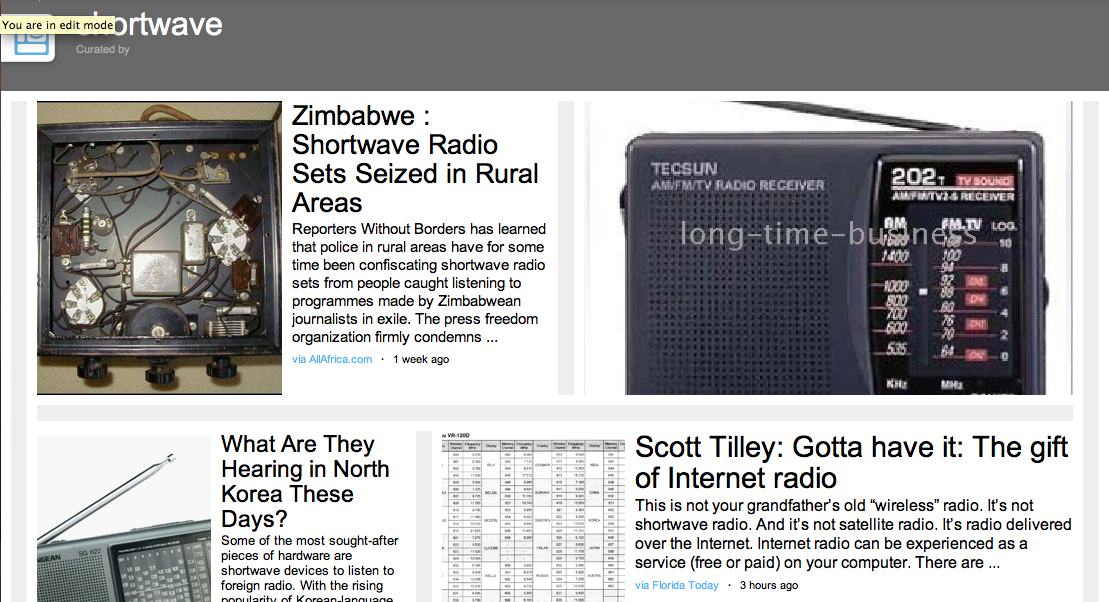
Montage, il Web magazine istantaneo di Microsoft


Con un ufficio a Redmond e uno a Cambridge, Regno Unito, i Fuse Labs sembrano fatti apposta per smentire anni di scetticismo sulle capacità innovative di Microsoft. Tra i tanti progetti molto stimolanti messi a punto dai Fuse Labs c'è Montage un meccanismo di mashup che può ricordare l'interfaccia dei quotidiani istantanei di Paper.ly, ma è decisamente più orientato al mondo dei tablet e non richiede l'identificazione di specifici flussi da impaginare. Montage consente in pratica di realizzare un "instant magazine" molto elegante e ricco di illustrazioni, mettendo insieme notizie, twitter e altro materiale estratto dal Web e dai siti Microsoft sulla base di una parola chiave. Le riviste possono essere ulteriormente personalizzate e condivise tra gli amici. Quelli che vedete qui sono i due risultati ottenuti con "radio" e con "shortwave". Provate anche voi Montage a questo indirizzo: