Visualizzazione post con etichetta ricerche. Mostra tutti i post

13 aprile 2016

Edison Research, per gli americani al volante la radio tradizionale batte lo streaming 4 a 1

Il "grafico del giorno" del sito di data journalism Statista si basa su informazioni Edison e conferma il ruolo maggioritario che la piattaforma radiofonica analogica (più forse qualche decina di migliaia di apparecchi HD Radio, ma i dati non lo dicono) continua ad avere tra gli automobilisti americani. L'ascolto tradizionale della radio è in declino a fronte di una maggiore penetrazione dell'ascolto online, ma a bordo dell'auto, almeno negli Stati Uniti, funziona ancora benissimo. L'84% dei guidatori accende l'autoradio, a fronte di un modesto 21% che consuma contenuti streaming. Più o meno la stessa percentuale utilizza servizi satellitari, che tra parentesi registrano un record: l'operatore SiriusXM proprio oggi ha dichiarato il superamento della soglia di 30 milioni di abbonati dopo averne raccolti 465 mila solo nel primo trimestre del 2016.


Infographic: Radio Still Rules The Road | Statista
You will find more statistics at Statista

Probabilmente questo zoccolo duro a quattro ruote vale anche per l'Italia, anche se mi piacerebbe avere dei dati più precisi. La questione del consumo di servizi streaming come le Web radio anche in mobilità è fondamentalmente legata alla copertura offerte dalle reti mobili e al costo percepito da chi ascolta. Nell'ormai ultradecennale lotta tra modello tradizionale e piattaforme IP (broadcast versus broadbad), un aspetto non trascurabile continua a essere quello della sostanziale gratuità della radiofonia che abbiamo conosciuto finora e i costi che nel caso delle Webradio sono ripartiti tra chi trasmette e chi riceve (ok, chi riceve sul proprio telefonino deve considerare il fatto che questo dispositivo serve per un intero portafoglio di servizi - telefonate, messaggistica, navigazione, ascolto in streaming - che non può non avere un costo). Su bacini di ascolto molto estesi il modello broadcast è senza dubbio vincente, tanto da essere adottato anche da sistemi di distribuzione come LTE, con i protocolli MBMS, Multimedia Broadcast Multicast Service (a proposito, Fabrizio Mondo, inventore di Zeptle, la piattaforma di "orientamento" e accesso alle radio Web e tradizionali, ha meritoriamente tradotto la corrispondente voce per Wikipedia italiana).
Personalmente non vedo ragione di porre ostacoli all'adozione di modelli distributivi alternativi, ma nemmeno per credere che il futuro del broadcast, analogico o digitale che sia, debba necessariamente essere segnato, se non forse sul lunghissimo termine. In ogni caso è una discussione interessante, e l'online ha dalla sua un indubbio primato: quello della democratizzazione. Fare radio su Web è più che mai alla portata di tutto, mentre soprattutto in Italia, la radio convenzionale è ancora troppo ingabbiata in (non)regolamenti che favoriscono solo chi trasmette già. E si sta visibilmente annoiando, visti certi contenuti.

24 maggio 2010

Due studi sul consumo di radio online

La National Broadcasters Association americana analizza due recenti studi sul consumo online di programmi radiofonici, le ricerche presentatate da Arbitron/Edison Reesearch (Digital Platform and the Future of radio, di cui ho già parlato) e Radio Futures 2010 di Vision Critical, una società newyorkese. Il primo conferma l'enorme popolarità dei mezzi online, rivelando tra l'altro che il mezzo con il maggiore impatto sulla vita degli americani è ormai il telefonino, seguito dal televisore, da Internet e solo al quarto posto dalla radio.
Sarebbero ormai 43 milioni gli americani che hanno una frequentazione della radio su Internet su base quotidiana nell'arco della settimana.
Vision Critical cerca di andare più a fondo in questa nuova abitudine e scopre che mentre in Canada e Regno Unito si va su Internet per ascoltare la radio convenzionale, gli americani tendono a privilegiare molto l'offerta "solo Web" di Pandora e compagni. I due studi possono essere prelevati online ai seguenti indirizzi: Arbitron/Edison Study e Vision Critical.

Surveys Track Online, Broadcast Media Usage
Many (if not most) radio broadcast engineers are responsible not only for keeping a station’s signal on-the-air, but online as well. According to two recent surveys (discussed below) of online and broadcast media usage, online streaming services are becoming more popular with listeners, and consequently they are likely to continue to play an ever-increasing role in broadcast engineering activities.
One of these surveys was conducted jointly by Arbitron (Columbia, Md, www.arbitron.com) and Edison Research (Somerville, N.J., www.edisonresearch.com), who have been studying the impact that digital platforms are having on radio and other media since 1998. Their 18th study in this series, released in April of this year, is called “The Infinite Dial 2010: Digital Platforms and the Future of Radio.” It provides a wealth of information on consumer usage of digital media including some interesting statistics on the use of social networking sites, declaring social networking a “mainstream behavior” and Facebook in particular an “essential platform.”
For the Arbitron/Edison Research survey, a total of 1,753 persons in the U.S. were interviewed from January 25 to February 22, 2010. Telephone interviews were conducted with respondents age 12 and older, chosen at random from a national sample of Arbitron's Fall 2009 survey diary keepers and through random digit dialing (RDD) sampling in certain geographic areas where Arbitron diary keepers were not available for the survey. Some of the key findings pertaining to radio and digital platforms include:
Listening to online radio – according to the survey, an estimated 70 million people in the U.S. listened to online radio in the past month. Shown in the graph is the trend for weekly online radio listening since 2000, with 17 percent of people 12 and older having listened in 2010 which represents approximately 43 million. Three in ten 12-to-24 year olds are "very interested" in online radio in the car and on mobile devices.
Listening at work – nearly one in four (23 percent) of people who listen to the radio at work now do so using the Internet (see graph), which is nearly double from the amount of people who did so in 2007. Other statistics regarding online listeners indicate that they are slightly more likely to be male than female (55 versus 45 percent) and that they are more likely to be “upscale,” well-educated and employed than those who do not listen to online radio.
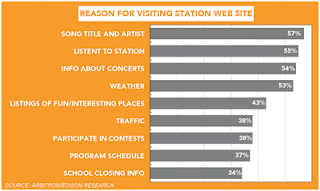
Visiting station Web sites – shown in the figure at right are the reasons that people give for visiting a station’s Web site, with “song title and artist” being the most popular. Consumers say radio station Web sites are improved compared to a year ago but TV and print sites are leading the local battle. Monthly visitation by persons 12 and older to radio station Web sites (16 percent of those responding) lags visitation to local TV (27 percent) and local newspaper (also 27 percent) sites. Nearly half of people age 12 and older give credit to radio for improvements in their W
eb sites. Forty-eight percent say that radio station Web sites have gotten more interesting compared to 17 percent believing them to be worse or less interesting.
Greatest total impact – the survey asked respondents to indicate which platforms and devices have a “big impact” on their lives, and the resulting data was combined with the percent who use or own those devices and platforms to create a measure of the “greatest total impact” shown in the graph at right.
Interactive research and technology firm Vision Critical (New York, NY, www.visioncritical.com) conducted a survey and released the results (also in April 2010) in a report entitled “Radio Futures 2010.” Vision Critical surveyed more than 3,000 adults in the U.S., U.K. and Canada and found that while those in Canada and the U.K. are using applications on their smartphone or iPod Touch to listen to AM/FM radio, U.S. users are more likely to use their apps to listen to Web-only radio and music streaming services. Among adults in the U.S. who have listened to online-only radio in the past month (see graph below), Pandora leads the pack as the favored online music service (42 percent having listened in the past year), followed by Rhapsody (6 percent), last.fm (5 percent) and Yahoo! (5 percent).
At the time of the survey, nearly one-third (31 percent) of U.S. smartphone and iPod Touch users said they’ve listened to Internet radio or a music streaming service on their device in the past week. In contrast, just 19 percent reported listening to an AM or FM station on the same platform.
According to the Vision Critical study, listeners to Web-based services expressed a clear preference for personalized versus “one-way” broadcast streams. Online consumers who turn to Web-only music or streaming service in the past month showed a particularly active interest in services that offer some degree of control. Fifty-three percent of respondents said that they were “very interested” in streaming where it is possible to play a song on demand, while only 24 percent were very interested in radio that plays music mixes designed by “music experts.”

12 marzo 2010

Osservatori del "Poli": nuova tv nella crisi mediatica

Hanno fatto come al solito un lavoro eccellente gli amici degli Osservatori del Politecnico e del Cefriel nel confezionare il loro annuale rapporto sulla "nuova" televisione, la tv ormai alternata tra i due modelli, entrambi compositi, della Sofa TV e della Desktop TV, affiancati da un terzo incomodo ancora molto embrionale chiamato Hand TV. Come sempre il rapporto è denso di considerazioni e cifre che ci consentono di formulare valutazioni molto obiettive. E non mancano dati di mercato interessanti per l'intero comparto mediatico, radio inclusa.
Parto proprio dalle cifre complessive fornite relativamente ai valori in gioco. Secondo gli Osservatori il mercato italiano dei media nel 2009 subisce una contrazione pesante, di nove punti percentuali, passando da 18,52 miliardi del 2008 a una stima di 16,79 miliardi. Tra 2007 e 2008 c'era stato invece un aumento, piccolo ma pur sempre positivo. L'anno scorso c'è stata la débacle, dovuta soprattutto al calo di fatturato pubblicitario della carta stampata. Un quinto di contrazione rispetto ai valori precedenti. La tv perde, ma in proporzione perde la metà. La radio perde il 14%. E infatti ci ritroviamo con in mano una torta di pesi relativi che vede la tv contare ormai per il 56% del valore totale, la stampa scendere al 35%, la radio passare del 3% al 2% e il Web che passa dal 4% a un comunque modesto 5%. Il valore della comunicazione su dispositivi mobili mantiene una quota del 2% da ormai tre anni e non credo che andrà molto diversamente nel prossimo futuro. E' uno scenario deprimente, che stupisce ancora di più se si pensa che in Italia l'intero sistema della politica e delle poche regole fondamentali rimaste si fonda in maniera quasi assoluta sul valore economico del comparto in cui opera l'azienda del Presidente del Consiglio. Tra le linee di tendenza individuate dagli esperti del Politecnico di Milano c'è un dato importante, anche e soprattutto per la politica: Per la prima volta la pubblicità non è il motore maggioritario del mercato che poggia ormai per il 53% su modelli "pay". Nei due anni precedenti i due motori avevano mantenuto un perfetto equilibrio, con il 50% ciascuno.
Che cosa ne sarà della carta stampata per cui lavoro e della radio che amo? Trovo curioso che i due comparti sembrano entrambi aver ceduto un pezzo, il primo alla televisione il secondo al Web. Ma è difficile prevederne l'andamento futuro, soprattutto considerando che non ci troviamo più davanti a sottoinsiemi rigidamente definiti. Quello che i dati sembrano dirci è che l'industria mediatica nazionale ha un disperato bisogno di aria pura, qualità e regole: poche, uguali per tutti e non soffocanti, esattamente il contrario di quanto sta avvenendo da diversi anni a questa parte. Un comparto mediatico che perde il doppio rispetto a un PIL peraltro in stato comatoso, rappresenta un duplice fallimento in una Nazione che si sta facendo comandare a bacchetta da un presunto "genio" della comunicazione. Si comincia a intravvedere quali possano essere le conseguenze di regole fatte apposta per far prosperare pezzi molto mirati di una macchina complessa che avrebbe bisogno di liberismo economico e tecnologico moderno, autentico, non certo gli obrobri in stile sovietico come la Gasparri, le Milleproroghe e i bavagli da "par condicio".
Temo soltanto che questa decadenza sia ormai irreversibile, perché nessuno intende cercare una soluzione vera.

31 marzo 2008

LOFAR, antenne rubate all'agricoltura

Fioccano un po' ovunque, persino sulla faccia nascosta della luna, i progetti per la realizzazione di radiotelescopi nelle basse frequenze. In radioastronomia per "bassa frequenza" si intende una soglia inferiore ai 250 MHz, in cui sulla terra le antenne avrebbero parecchi problemi di interferenza. Un articolo del Guardian parla di un premio europeo (che tra parentesi coinvolge altri progetti seguiti da scienziati e ricercatori italiani, l'economista Luisa Corrado e l'ingegnere Andrea Ferrari, entrambi della Cambridge University) a Robert Nichol, cosmologo della Portsmouth University, per la sua collaborazione a LOFAR. Infine c'è il progetto SKA, Square Kilometer Array, un radiotelescopio a larga banda internazionale che dovrebbe essere ospitato in Australia o in Sud Africa (si deve ancora decidere, ma sembra che l'Australia abbia qualche chance in più). Anche SKA dovrebbe essere costruito entro il 2015-2020.

Europe-wide radio net in aliens search

Project will pick up clues from space on possible extraterrestrials and data on the early universe

Observer on Sunday March 30 2008

Scientists are finalising plans to link radio wave detectors in five countries and create a device sensitive enough to pick up signals from worlds the other side of the galaxy.
By connecting banks of detectors in fields across Britain, France, Holland, Sweden and Germany, astronomers aim to create a radio telescope that will have the accuracy of a machine the size of Europe. They believe it could solve some of the universe's most important secrets - including the discovery of radio broadcasts from intelligent extraterrestrials.
'This system works by collecting radio waves over a range of frequencies,' said cosmologist Robert Nichol of Portsmouth University. 'These can then be analysed using arrays of computers which can identify patterns from the data streaming from our detectors.
'Some of these signals will reveal information about the early universe, for example. However, broadcasts by alien intelligences would also be revealed by our computers because we will, primarily, be collecting radio signals. Signals that have regular patterns will give themselves away as the possible handiwork of extraterrestrials. Such work is a bonus, however. The main work of the system is basic research,' added Nichol.
The project - known as Lofar (low frequency array) - was launched in Holland several years ago, but has attracted the attention of other European astronomers. All have agreed to build their own banks of detectors, which can then be linked to those in Holland. Britain is committed to building one set, while requests for money for another three have been put to research councils.
(continua)
L'idea dietro a LOFAR sembra veramente una pensata di un gruppo di radioamatori: disseminare su scala continentale una rete di sensori RF da unire via software. Uno dei bersagli di queste antenne è la radiazione di fondo generata nei primi istanti di vita dell'universo. I sensori vengono "semplicemente" disseminati nelle aree a sfruttamento agricolo e operano in due segmenti 30-80 MHz e 120-240 MHz. Il sito LOFAR spiega tutto molto bene, incluse le tecniche di RFI mitigation, cioè di lotta e compensazione delle interferenze RF e la ricaduta in termini di opportunità di controllo e management delle risorse agricole. La rete di sensori - e stiamo parlando di almeno diecimila antenne - verrà integrata da sistemi per la misura del microclima agricolo, con l'obiettivo di combattere le malattie dei raccolti.
Nel frattempo al MIT e altrove sognano di costruire, con sistemi robotizzati, un analogo array sulla luna, anzi sulla sua faccia perennemente nascosta alla terra e alle sue fonti di interferenza. Vi suggerisco la lettura del comunicato stampa del MIT relativo al Moonscope.

23 agosto 2007

Ofcom: le comunicazioni convergenti nel 2007


Cinquanta ore alla settimana. Sette al giorno. Hmmmmm. Questa, secondo il regolatore britannico Ofcom, la media di tempo che il consumatore mediatico del Regno Unito trascorre utilizzando il telefono, Internet, la Tv e la radio. Come dire che il nostro organismo ha bisogno di sette ore di sonno e sette di multimedialità. Questa e tantissime altre le informazioni che potrete trovare nella edizione 2007 dell'atteso Report sulle Comunicazioni che Ofcom pubblica da quattro anni, nel mese di agosto. Lo potete prelevare da questo indirizzo Web (attenti, sono tre installments da circa 1,5 MB ciascuno). Quello che segue è un dettagliato riassunto pubblicato oggi da All Media Scotland
Per me, uno dei dati più interessanti è quello sulla penetrazione delle radio DAB in UK. La venidta ha superato i 5 milioni di pezzi quest'anno: oggi, il 17% delle famiglie inglesi possiede una apparecchio DAB. Insoma, un discreto mercato questa radio digitale. Ofcom lo definisce nella fase di "early majority", ma i lettori MP3 sono molto, molto più diffusi. Contemporaneamente, la "radio digitale" viene consumata (33% dei consumatori, un dato superiore a quello individuato da RAJAR nei giorni scorsi) anche attraverso i set top box della DTV, Internet, telefonini (chissà se ci si riferisce alla sezione FM dei telefonini).

TV, Radio, Internet and Phone Taking up Fifty Hours a Week
23/08/2007

As ‘consumers’, we each apparently spend an average 50 hours on the phone, surfing the internet, watching television or listening to the radio - according to figures published today by broadcasting regulators, Ofcom.
Says Ofcom, in its annual Communications Market Report, average daily internet use last year (36 minutes) was up 158 per cent on five years ago, and time spent on the mobile phone (almost four minutes per day) was up 58 per cent. Time spent watching TV was down four per cent, at three hours and 36 minutes, listening to radio was down two per cent at two hours and 50 minutes and time spent on a fixed line phone was down eight per cent at seven minutes.
However, while consumers are getting more out of their communications services, the amount they are spending on them continues to fall. Last year, the average household spend on communications services was £92.65 per month, down from £94.03 the previous year.
Among the highlights, over 75 per cent of 11 year-olds now have their own television, games console and mobile phone. And some 15 per cent of 13-to-15 year-olds and seven per cent of 10 year-olds also have their own webcam.
Also, fewer children are playing console and computer games (61 per cent regularly did so two years ago, down to 53 per cent now), watching videos and DVDs (59 per cent did so regularly two years ago, down to 38 per cent now) and listening to radio (40 per cent listened regularly two years ago, down to 20 per cent now). Instead, they are using their mobile phones more often (50 per cent regularly did so two years ago, compared with 53 per cent now), surfing the internet (47 per cent regularly two years ago, compared to 52 per cent now) and using MP3 players (20 per cent regularly two years ago, compared to 28 per cent now).
Meanwhile, older people are also consuming more media. The over-55s was the only age group to increase its average radio listening between 2002 and 2007 (up 5.5 per cent). And older people are not just increasing their use of traditional media. Some 16 per cent of over-65s use the web. These ‘silver surfers’ spend an average of 42 hours online every month, more than any other age group. Indeed, far from being just a young person's technology, one quarter of all UK internet users are over 50 and the over-50s account for 30 per cent of total time spent online.
And among 25-34 year-olds, women spend more time using the internet than men. In this age group, 2.18 million young women users account for 55 per cent of total time spent online. By comparison, just 1.83 million 25-34 year-old men in the UK use the internet.
Digital television - in 80.5 per cent per cent of UK homes by April this year - is changing what, when and how we watch. One of the new services being used by viewers in the 11.5 million subscription television households is high-definition (HD) television. The report finds that, in the 450,000 homes that have it, 33 per cent of viewing time is spent watching in HD and 43 per cent of those surveyed said that they watch more television - especially premium content such as films and sport - as a result of having HD.
And by April this year, 15 per cent of respondents said they had a digital video recorder (DVR), almost double the number at the end of last year. DVRs allow users to record whole television series and to pause and rewind live programmes.
Radio listeners have a much wider choice of stations and ways of listening due to the growth of digital radio. Last year, the total number of DAB digital radio sets sold broke through the five million mark and 17.2 per cent of UK homes now have a DAB digital radio. DAB sets accounted for 18.6 per cent of all radio sales last year (1.8 million sets) compared to 12.9 per cent the year before (1.5 million sets).
DAB is not the only way that consumers listen to digital radio. The report finds that 33 per cent of consumers have listened to the radio via digital television (15 per cent do so at least weekly), 21-22 per cent listen online (12 per cent at least weekly) and 10-12 per cent listen via their mobile phone (six per cent at least weekly).
On the advertising front, UK television advertising revenue last year fell by 2.2 per cent on the previous year to £3.5 billion, the first fall since five years ago. The decline in advertising revenues coincides with greater availability and use of television-style content online and the growth of digital video recorders (DVRs) that allow users to skip adverts, putting even greater pressure on advertising revenues. The report found that up to 78 per cent of DVR owners regularly used them to skip through adverts.
Declining advertising revenue is, however, increasingly being supplemented by alternative sources of income. Last year, subscription revenues increased to £4 billion (approximately £350 per subscription), up from £3.3 billion the year before. Similarly, revenues from interactive services, such as quiz television channels and participative voting in programmes, increased by 18.3 per cent during last year to £123 million, although this new source of income may be affected in the future as broadcasters review their approach to interactive TV.
While television advertising overall is declining, revenues for digital-only free-to-air channels, such as ITV2, More4 and Five Life, is rising and for the first time broke though the £1 billion mark last year, a 21 per cent increase over the previous year. Revenue for the three commercial terrestrial channels - ITV1, Channel 4 and Channel 5 - stood at £2.4 billion last year, 9.6 per cent lower than the year before.
As television advertising revenue declines, online advertising spending continues to surge, up 47 per cent during last year and just breaking the £2 billion mark. Internet advertising
spend is now equivalent to almost half (44 per cent) that spent on all TV advertising, to 83 per cent of advertising spend on ITV1, Channel 4 and Five and to one quarter (24.2 per cent) of all press advertising. By April this year, 53 per cent of UK households had a broadband connection.
While the total number of radio stations in the UK has increased through the expansion of DAB (in June this year, there were 389 radio stations in the UK, 169 of which were available on DAB), the report shows that the total number of radio listening hours declined to an average of 19.8 hours per week per listener last year. This fell further to 19.4 hours between January and March this year. This decline has been felt most in the commercial local radio sector. Between April two years ago and April last year, average listening to local commercial radio fell by 4.1 per cent.
As listening has declined, so has commercial radio advertising revenue. Between 2001 and 2006, radio's share of total advertising revenue in the UK fell by 14.3 per cent and last year stood at £480 million. Total revenue for local commercial stations fell by 9.5 per cent from £169m two years ago to £153 million last year.
By contrast, the report finds that people are increasingly tuning-in to BBC radio. In the first three months of this year, four out of the five most listened-to stations were all BBC. The top five were: BBC Radio 2, Radio 1, Radio 4, Classic FM and Five Live.
The report also estimates that the BBC's expenditure on radio, at £637 million last year, is at its highest level in five years. This compares to £512 million for the commercial radio sector, at its lowest level since five years ago.

18 febbraio 2007

AM, stretta va meglio


Un documento appena rilasciato dal National Radio Systems Committee americano si inserisce a perfezione nel dibattito sulle considerazioni qualitative delle emissioni digitali. Il NRSC è andato ad analizzare con uno studio approfondito le caratteristiche di banda dei ricevitori per le onde medie e ha altresì studiato la reazione soggettiva degli ascoltatori in presenza di trasmissioni alarghezza di banda sensibilmente inferiori ai 10 kHz che costituiscono la spaziatura standard autorizzata tra le frequenze delle onde medie negli USA (in Europa e Asia sono 9 kHz). Lo studio è stato commissionato sulla base di considerazioni molto pratiche. Il NRSC rivela che numerose stazioni radio americane riducono la banda utilizzata (attraverso l'uso di pre-processori audio) per ridurre il fenomeno delle interferenze tra un canale e l'altro. In questo modo è possibile coprire bacini di utenza più estesi, evitando di disturbare le emittenti lontane.
The AM Broadcasting (AMB) Subcommittee of the National Radio Systems Committee (NRSC) was formed in 2004 to maintain NRSC standards relating to analog AM broadcasting.
Currently, the Subcommittee has three standards under review: NRSC-1, NRSC-2 and NRSC-3, dealing with (respectively) AM broadcast preemphasis/deemphasis and audio transmission bandwidth, emission limitation for AM transmission, and audio bandwidth and distortion recommendations for AM receivers. As part of the standards maintenance process, the Subcommittee can reaffirm, modify or retire these standards.
During the initial discussions within the Subcommittee regarding these Standards, it was noted that some broadcasters have already reduced the bandwidth of their analog AM signals from the 10 kHz specified by the NRSC standards to 5-6 kHz, in an effort to reduce the interference in the band, and with the understanding that most consumer receivers are band-limited to 5 kHz or less. A proposal was put forth that the NRSC consider reducing the bandwidth specification in NRSC-1, -2, and -3 to something less than 10 kHz, but the Subcommittee agreed that before such an action could be considered, a rigorous study of both analog AM receivers (characterizing, among other things, receiver bandwidth) and consumer reaction to reduced bandwidth would need to be conducted.
Vista la situazione, il NRSC si è chiesto se non fosse il caso di modificare le regole relative ai 10 kHz, in vista di una riduzione complessiva delle interferenze e soprattutto in considerazione del fatto che quasi tutti i ricevitori oggi utilizzati per ascoltare le onde medie hanno filtri da 5 o 6 kHz. Prima di qualsiasi modifica, il comitato si è prefisso l'obiettivo di uno studio scientifico della questione. La lettura del documento (disponibile in versione abbreviata e estesa) è molto, molto istruttiva. Dopo aver chiesto a un panel di persone di esprimere il proprio giudizio sulla piacevolezza dell'ascolto dei programmi la NRSC conclude per esempio che per le stazioni takl e news l'orecchio si sente addirittura più a suo agio con larghezze di banda di 5-7 kHz invece di 10.
Il che fa molto riflettere sulle ragioni qualitative del digitale, anche tenendo conto del fattore compressione e adattamento: uno spettro audio analogico ricostruito a partire da quello digitale trasmesso, è infatti diverso dall'originale audio campionato da''analogico in digitale. La compressione non è per forza di cose "loss-less" come si dice tecnicamente. E' uno dei motivi per cui il DAB è stato aggiornato in DMB. L'idea era di rimediare alle limitazioni di una compressione che produceva un audio metaliico e poco piacevole. Trovo che questo tipo di studi andrebbe esteso e approfondito. E' notevole vedere che l'orecchio umano sembra preferire una trasmissione a banda più stretta rispetto a una più larga e sarebbe molto interessante capire qualcosa di più sul confronto tra spettri audio originali (magari compressi e ottimizzati con tecniche digitali, ma non campionati al momento di trasmetterli) e spettri ricostruiti dopo la trasmissione digitale.
Autorizzare le stazioni a usare spettri di emissione più ristretti potrebbe anche cambiare completamente le carte in tavola per quanto riguarda l'allocazione delle frequenze e la spaziatura dei canali. Queste sono in sintesi le conclusioni tratte dall'executive summary della relazione:
Under the supervision of the NRSC’s AM Study Task Group, laboratory measurement of consumer AM receivers was completed in late 2005, establishing that the majority of these receivers have audio bandwidths of 5 kHz or less. Based on those findings, subjective testing was designed and conducted in two phases between February and May, 2006. In Phase 1, “broadcast-industry” participants determined an intermediate bandwidth, between 5 kHz and 10 kHz, to be included in the consumer test (7 kHz was selected). In Phase 2, consumers judged which transmission bandwidth at 5 kHz, 7 kHz or 10 kHz had better quality, the magnitude of the differences and whether they would continue to listen to the radio, given the quality of each of the samples. Testing included audio samples impaired by first-adjacent channel interference in addition to unimpaired reception. Consumer test results suggest the following:
• Perceived differences in audio quality between 5, 7, and 10 kHz bandwidth were small for most genres. For music, commercials and sportscasts, little difference was heard between 7 and 10 kHz, regardless of adjacent channel interference conditions. For speech, which does not mask noise and interference, larger differences were perceived, based on impairment conditions.
• In unimpaired or slightly impaired conditions (as determined by the desired-to- undesired signal ratio, D/U), people tended to prefer higher bandwidths to lower
bandwidths. However, 7 and 10 kHz had equal preference.
• With speech in moderate to heavy impairment conditions participants preferred lower bandwidths (5 and 7 kHz) to higher bandwidths, despite a mutual reduction in transmission bandwidth on the desired channel.
• The data suggest that the rather substantial “turn-off” rate with heavy impairment can be ameliorated by using a lower transmission bandwidth. Overall, although there was some variation in preference between genres and D/U ratios, the data strongly suggest that in general consumers preferred lower bandwidths (between 5 and 7kHz) to higher bandwidths.
Vi suggerisco la lettura di questo studio in versione estesa, dove troverete anche le schede sui ricevitori analizzati. Tra i modelli elencati c'è una autoradio HD Radio ready, ma immagino che le prove siano state svolte in modalità analogica. I dati forniscono diversi dettagli inediti su apparecchi abbastanza noti nella comunità dei DXer. Un lavoro nel complesso molto interessante, che dimostra un approccio davvero olistico alla problematica della radiofonia. Si arriva così a conclusioni che mettono un po' in dubbio il positivismo ultraindustriale di chi da anni va ripetendo i miti della "CD quality" e sulla superiorità dell'audio digitale. Non dico che i positivisti abbiano sempre torto, ma il problema rimane: certi discorsi partono dalla mistica contemplazione degli spettri audio, dall'esoterismo irragionevole di chi insegue l'ultimo armonico prodotto dagli archi della grande orchestra. Veicolare tutto questo attraverso la compressione digitale è molto bello, ma il nostro orecchio percepisce spettri ricchi e complessi, ma non necessariamente estesi. Forse è per questo che si accontenta dei 7 kHz di parlato fedele all'originale analogico e disdegna i 20+20 khz trasmessi in pochi kilobit compressi. Il settore della radio fa molto bene a ragionare di queste cose, perché è veramente assurdo che miliardi di radioascoltatori si vedano costretti a sposare la causa del digitale solo per far piacere a tre produttori di chipset. La musica digitale esoterica, nel frattempo, continuerà a funzionare molto bene sui super-DVD e con gli amplificatori e i processori audio di fascia più alta.
A proposito di larghezza di banda nelle onde medie. Tempo fa il Medium Wave Circle ha pubblicato una paginetta davvero divertente sul suo sito Web, andando a confrontare tra loro, con gli aiuti dei programmi SDR, gli spettri ricevuti dalle stazioni analogiche e da quelle digitali in Europa, per studiare il fenomeno delle interferenze europee sui canali transatlantici (spaziati di 10 kHz e quindi sempre "sghembi" rispetto ai nostri). Sapete che cosa salta fuori? Che mentre certe stazioni analogiche barano sfacciatamente sul famoso limite dei 9 kHz di separazione tra un canale e l'altro, gli sperimentatori del DRM sono bravissimi a rispettarlo e appaiono quindi assai più virtuosi. Il confronto vede affiancati gli spettri ricevuti dalla BBC su 909 kHz (1 kW), quasi perfettamente nei limiti dei 9 kHz, quello di Virgin 1.215 e BiG L 1.395 kHz (ampiamente debordanti, fino a occupare 12 kHz, assurdi se si pensa che buona parte dei ricevitori ne taglierà oltre la metà!). E infine lo spettro di RTL 1.440 in DRM, perfettamente tagliato prima della linea dei ±4,5 kHz. I DXer si lamentano delle interferenze dai canali digitali, ma gli splatter (interferenze dai canali adiacenti) dalle stazioni analogiche causano altrettanti problemi.